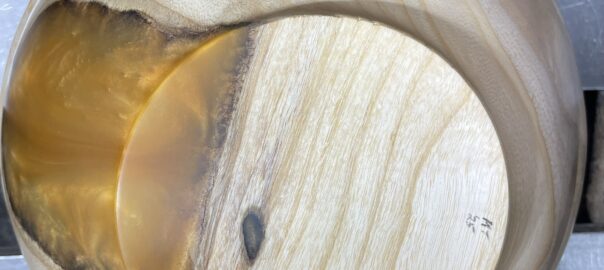
So this one took a long time to manifest…
At least 5 years ago, maybe closer to 10, a woman reached out to Bob, my mentor, to offer an ash log from a tree she had to have removed. She knew he was a woodturner and would rather see someone use the wood instead of fill up a landfill. It was from her house and had been a victim of the ash borer beetle that will eventually eliminate all ash trees from the ecosystem. Central Illinois has been hit surprisingly hard by this, so as time passes this wood becomes more rare. Bob was also a wood hoarder, but had stopped taking in new wood and asked me if I wanted any ash to turn. (He always joked that “you should never turn down a good piece of ash!”) I didn’t need more wood sitting around, but since I didn’t have much ash, I figured I should take it while it was available. When I asked him where the wood was and how to pick it up, he gave me the name/number of the woman who called him and I froze. Turns out this was a woman I had worked extensively with LONG before I had even started to turn wood.
Small world, eh?
I went to her house and picked up the log, telling her it would be quite awhile before I got around to doing anything with it. Weeks turned to months, months to years, and last week I literally tripped over the log. It was dry when I got it, so I didn’t have to do anything to prevent cracks, and it had been relegated to a dusty corner of the shop. I decided to take a piece of the wood, just to see if it was still good.
When I started looking closer at the log, there was a definite mixed bag. On the up side, it was still dry, didn’t show any signs of movement, and Bob was right in that ash turns beautifully! BUT… It had one huge issue in that it looked like it had been damaged at some point in its life and tried to repair itself. From the damage, it looked like the wood had a massive place, maybe 6″ or so, where the bark had been torn off that ran the entire length of the log. The really troubling part is that the tree tried to “grow over” the damaged part. Not a showstopper, but the tree was taken down long before the overgrowing process had a chance to complete. What was left, was a tree with a flat spot on in, flanked by two “rolly bits” on each side where the tree tried to cover the missing part of the tree. Worse yet, there was a huge split running between the rolly bits and the injured part. That made the prospect of using the wood somewhat limited.
When I started looking closer at the log, there was a definite mixed bag. On the up side, it was still dry, didn’t show any signs of movement, and Bob was right in that ash turns beautifully! BUT… It had one huge issue in that it looked like it had been damaged at some point in its life and tried to repair itself. From the damage, it looked like the wood had a massive place, maybe 6″ or so, where the bark had been torn off that ran the entire length of the log. The really troubling part is that the tree tried to “grow over” the damaged part. Not a showstopper, but the tree was taken down long before the overgrowing process had a chance to complete. What was left, was a tree with a flat spot on it, flanked by two “rolly bits” on each side where the tree tried to cover the missing part of the tree. Worse yet, there was a huge split running between the rolly bits and the injured part. That made the prospect of using the wood somewhat limited.
I knew the remaining parts of the “rolly bits” would crack off when I turned them, so I cut them off. As I tried to see what was left, I realized no matter how I mounted the bowl blank on the lathe, the outside of the blank would be missing part of the wood. That’s when I realized epoxy was my friend and came up with a plan to use epoxy to fill the missing part of the blank. The plan was to make a “dam” around the missing part of the blank, fill the void with epoxy, then put it back on the lathe and turn it like a normal bowl. The only thing left to figure out is what color epoxy to use. Solid color? No, that would be really bland. Layered colors? No, just did a project doing that. Mixed colors? Hummm…
I picked a bright, iridescent, orange and a bright, iridescent yellow, hoping I could use just enough yellow to bring gradual contrast, without they two colors mixing into a light orange. The thing about mixing epoxy is you have to do it blind. There’s no real indication of what you’re going to get, until everything is poured, the epoxy has set, and the turning is done. By that point, there’s no do-overs. Do it wrong and you’re out the cost of the epoxy, all your time, AND the blank is ruined. I did the pour and to be honest, I’m not unhappy with how things worked out!
This is what I ended with. Enough orange/yellow to blend well with the lightness of the ash, but enough contrast to see both colors without them fully blending. Add in the shimeriness (I’m sure that’s a real word) of the iridescence and this one came out good! Looking at it closer, the two colors actually blended together like they were meant to be together.
After all this time, I hope she likes it!
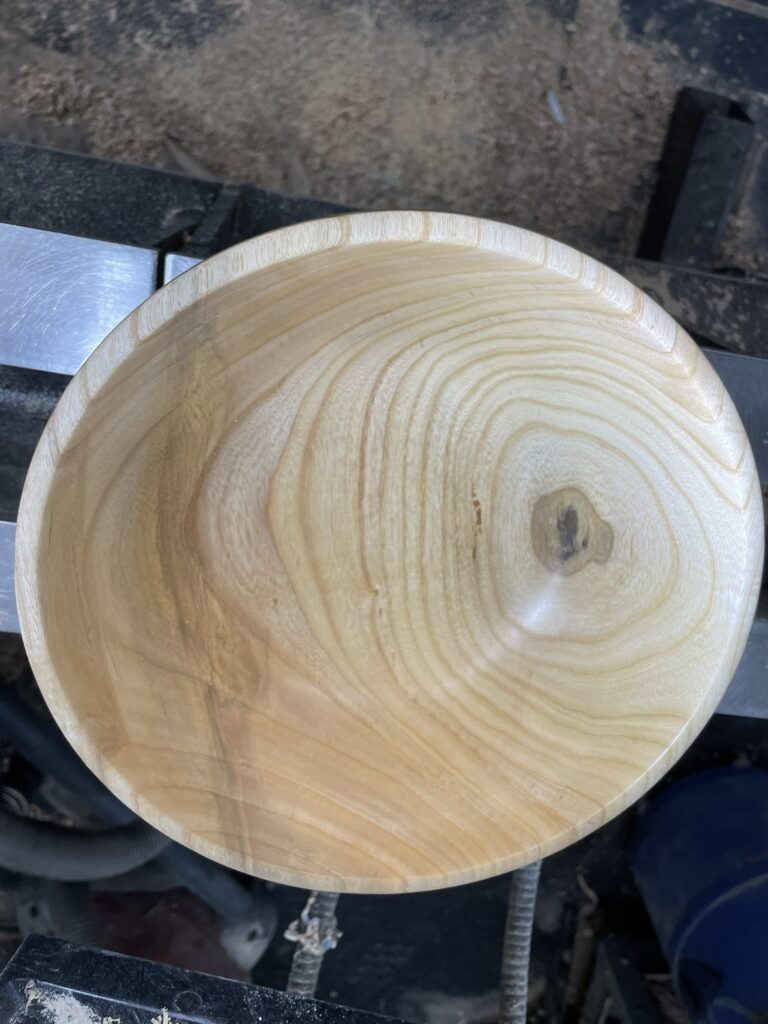
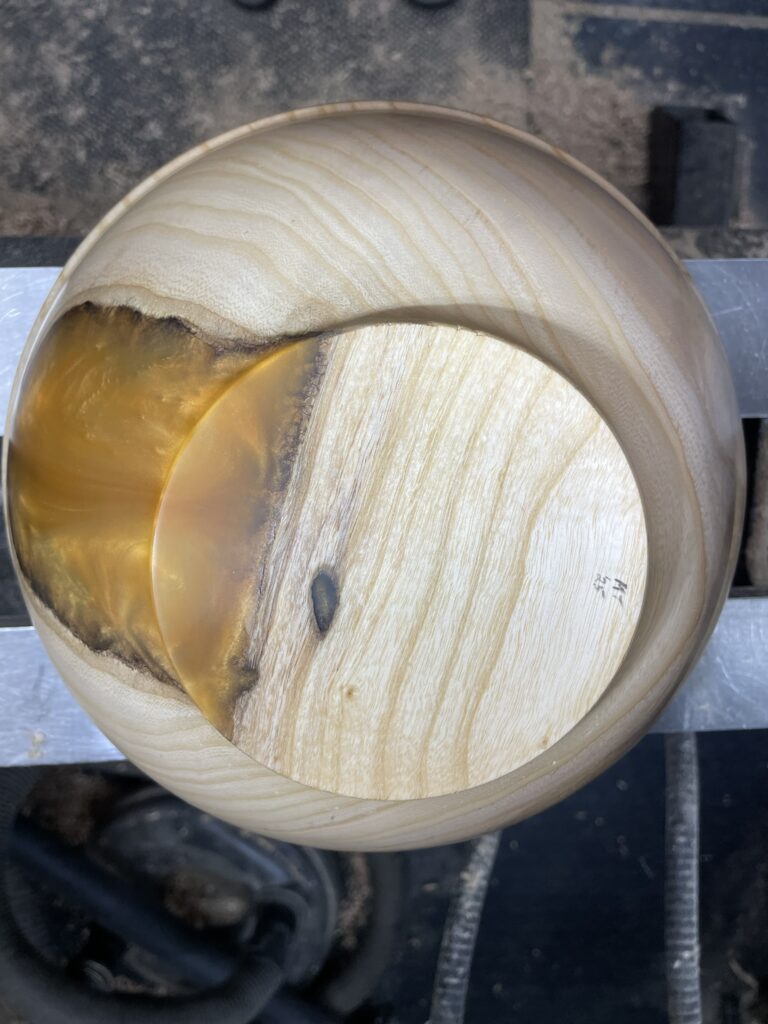
As I write this up, with the finished project setting beside me, there are some things that I noticed. First, I mentioned earlier there were “rolly bits” that i had to remove before turning, but they can still be seen. Not all of it, but on looking from the top, on the left hand side, there’s a clear line where the tree still shows the earlier damage. What doesn’t come out in the picture, is on the outer side of the bowl that isn’t shown, the wood has a permanent crack where the damage can be seen. Second, from the top, the epoxy patch is just starting to poke through. There’s too much to fully hide, but too little to make it be a accent. What’s left looks (to me) like a mistake. In hindsight, I should have turned less of the inside away to the patch was fully hidden, and taken more off the bottom so the bowl wasn’t too “bottom heavy”. Finally, I was looking at the epoxy much more closely and realized something. If you’re seen all the other things I’ve made, especially those that use the copper iridescent epoxy, it looks VERY similar to the mix of both the orange and yellow iridescent epoxy. I went back and got some projects made with just the iridescent copper epoxy and you’ll just have to trust me that they’re different, but I will admit up close they look oddly similar.