In the woodturning world, there’s this thing called “the funnel club”. It’s not prestigious to be a member. There are no meetings, no passwords, and no dues to pay. No one brags about being a member and absolutely nobody wants to join. The only way to become a member is to make one very specific mistake.
I joined the funnel club at least 15 years ago and had Bob (my friend and mentor) with me as an unwilling witness. Bob always told me that the first rule of woodturning is “the outside dimension of a turning must always be greater than the inside dimension”. I thought he was just making a joke. One night while just starting up the learning curve, I was working on a bowl, concentrating on the way I was presenting the chisel as it was slicing through the wood. Bob was watching me as I navigated the curve at the bottom of a bowl, specifically the part where the side of the bowl transitions to the bottom of the bowl. I heard Bob say “uh oh!”, but I just kept cutting away wood, focused on the lesson. In a matter of seconds I broke the cardinal rule and thereby joined the funnel club. I had removed so much wood that I went through the bottom of the bowl and created something woodturners refer to as a funnel. A funnel is an otherwise attractive bowl, but with a gaping hole that goes through the bottom.
Flash forward to today and I (very unexpectedly) renewed my membership. Insert face palm here!
It happened as I was trying to finish up work on a series of ash bowls I’ve been working on. While I was finishing the inside of the last bowl in the series, something didn’t look right. I turned off the lathe and looked closely at what I had done. As the understanding of the problem hit me, I hung my head in shame. I had, in fact, gone too far when removing wood, but I had done it in a very unique way. The funnel didn’t form as I was turning the inside of the bowl as expected, but I had turned the bottom of the bowl so deep that when I flipped the bowl to remove the tenon, the funnel would quickly form to ruin the project.
As I stood there in shame, looking at the project as I took it off the lathe, a slow smile spread across my face. I smiled because when I joined the funnel club way back when, Bob showed me how to fix it. He actually spent the next week’s lesson walking through the mechanics of the fix and what needs to be considered as the fix is made.
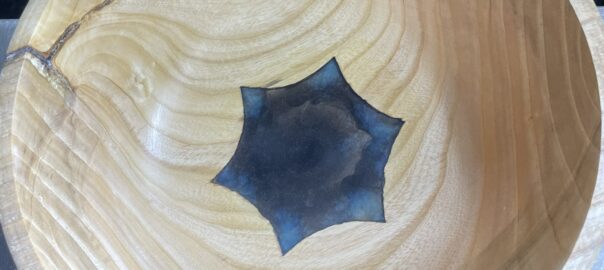
Bob’s fix was based on the premise that the hole would be enlarged until the thickness of the wood around the hole could accept what would become a new tenon made from contrasting wood. I decided to take a slightly different path. Since there’s no hole, there’s no turning to “prepare for the plug” and there’s no plug to turn. I figured I’d skip the who plug thing and fill the bowl’s divot with epoxy until the bottom thickness of the bowl was thick enough to turn. The result would be a small circle of epoxy in the bottom or the bowl. The more I thought about it, I realized I could drop the whole concept of leaving a circle, since the only important part was how thick the patch was.
Since I knew where the center point of the mistake was known, I used a compass to make a 6 sided figure centered on the bottom of the bowl. Then, using a power wood carving tool, I took some of the wood out of the bottom of the bowl, that was within the carved design. If all goes well, I’ll be left with an epoxy patch that’s shaped like the 6 sided figure.
The epoxy work and he carving went as expected, so after a day or two, I chucked the bowl back up to finish the turning. Surprisingly, when the bowl was turned around and the tenon was removed, there was enough wood left so the patch I made didn’t show on the bottom of the bowl. It doesn’t matter if it was close, the bottom line is I did NOT rejoin the funnel club!
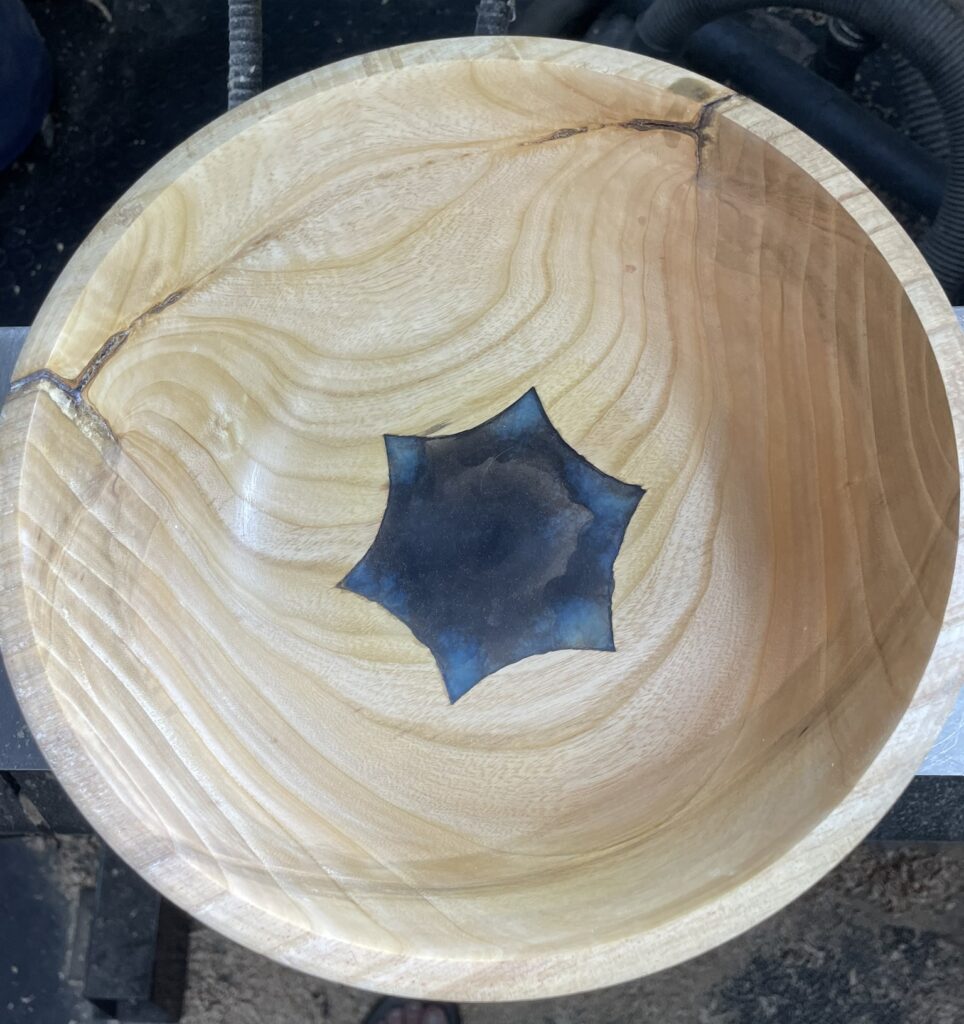
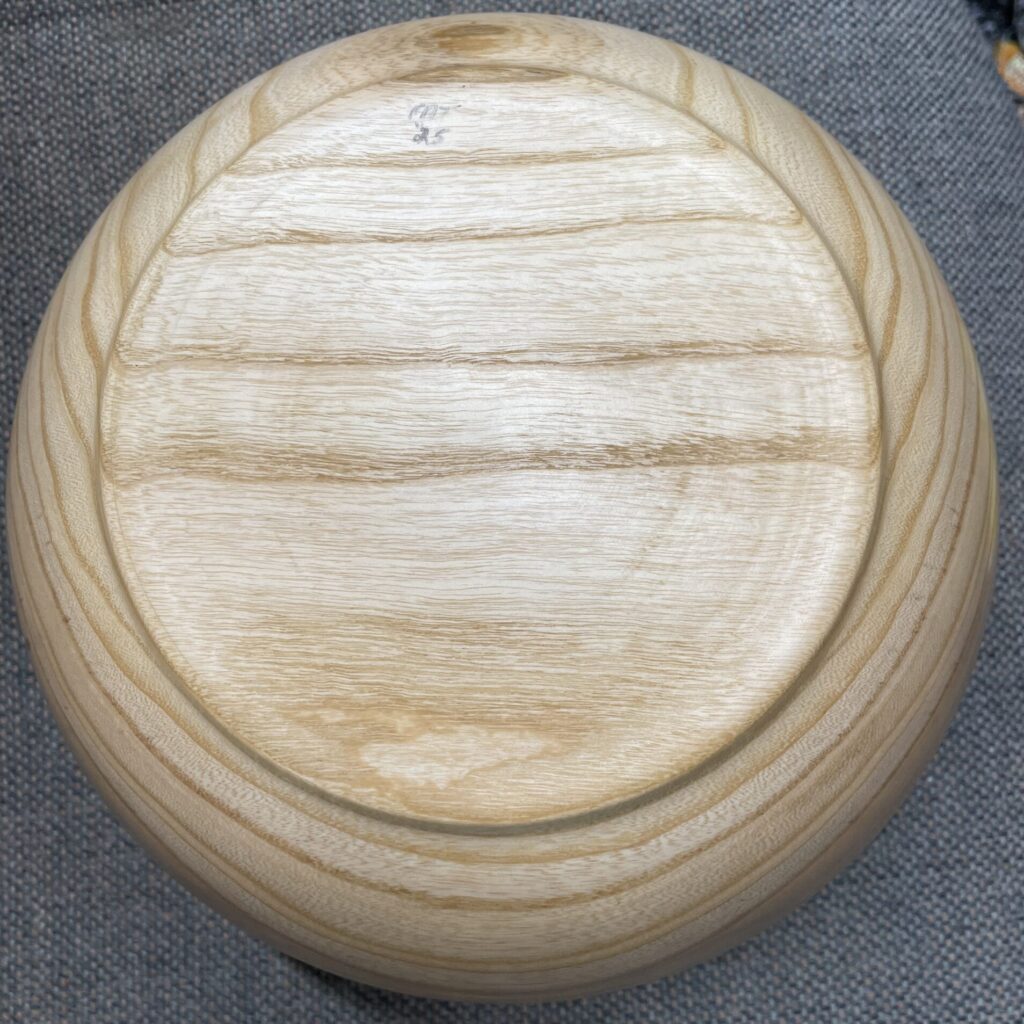
Once again this log started out with the damage to the tree itself. As a result, the crack on the top of the bowl can be seen, as well as a dark line on the bottom of the bowl showing the damage from the other side of the crack. Not the best, but this really was a practice piece!