Category Archives: blog

root folder for blog posts

Tinley’s bowl

Awhile back, I made “Wendy’s bowl” as a thank you to the attorney who’s finally been able to drag the dumpster fire of my divorce closer to the finish line. For the last several years, Tinley has been working alongside of Wendy to make sure all the little details are taken care of. Keeping track of documents, printing off the excessive reams of “evidence” that gets sent, making appointments, making phone calls, and even providing diet coke when she knows the meetings are going to run long and I’m under caffeinated. She also happens to be a very nice person with a smile for everyone.

This whole divorce nightmare really has been a circus! As with most circuses, The spotlight tends to shine brightest on the ringmaster (judge). In the other rings, under their own spotlights are the the graceful acrobats (My attorneys), the clowns (her seemingly endless string of attorneys), and the other acts that play to an audience (waiting attorneys, other litigants, and the random stranger). All of that, however, is dependent on some poor bastard who never gets to actually see the show, because they’re stuck back in the office, getting permits, arranging for porta-pots, getting flyers printed, buying hay for the elephants, and a million other things that have to be done to keep the circus going and the tents from collapsing. Tinley was that person for my divorce circus!

This bowl was made from a piece of spalted maple that a friend gave me earlier this spring. He had left the log sitting on a pallet in the middle of his woods. By the time I got it, there were literally different types of fungus growing on it and it had this black slimy “stuff” covering both ends of the log. I figured the wood was too far into the rotting process to be useful and would surely have cracks throughout that would make it impossible to turn, but I took the wood anyway because my friend really wanted to see what I could make out of it.

I took the log home and cut the slimy ends off so I could see what I was dealing with. To my surprise, there weren’t any cracks and the spalting on the end grain was insane! The thing about spalted wood is you can never tell by looking at the end grain how far into the rest of the tree the coloring goes. It all depends on the fungus that’s growing in the wood, how “aggressive” it is, and what kind of wood it’s growing in. While I was roughing out the bowl, the wood was so wet there was water flying off of the blank to the point my shirt was absolutely soaked and the ceiling had a line where water had been flung up. After a month in the desiccant, it had finally stopped losing water/weight, so I set it aside for the final turning.

The really cool thing about this bowl is the way it spalted. Not to jump too far into the weeds, but when the fungus grown in wood, it creates “zone lines” in the wood, which are usually black in color and cause the distinct coloration. In this case, there were black lines, green lines, and even some blue lines (that quickly turned into a dark grey as the wood was exposed to air). From my understanding, that’s a VERY uncommon occurrence for maple.

This picture was taken part way through the turning process. The part above the large bark inclusion was turned away to avoid eventual issues with cracking. The bark inclusion was stabilized with CA glue and left to be just under the rim of the bowl.

This is my thank you gift to Tinley, may small way of saying thank you for all the work, the smiles, and the encouragement she gave me while the circus was in town.

This is a view of the bowl from the top. Note how the spalting goes completely through the finished bowl. The bark inclusion can also be seen.

Wishing Well Wig Stand

One of the President’s challenges of my turning club is to make something with burning or carving. That’s a pretty wide open set of requirements. hit the grain with a blowtorch? That works. Wanna carve a flower on your project? Super, that counts. Wanna carve obscenities into the project like Chicago graffiti, throw it in the fireplace until it starts to burn, then put the fire out and add some wipe on poly? Great, can’t wait to see it. As long as something hot enough to scorch the wood, or some sharp tool (other than a lathe tool) was used to remove wood, the project would count toward the challenge.

When I was thinking about projects, I thought I should do something I hadn’t done before, or at least take an older project and step it up a notch or two. At about the same time, I had to drop off some completed wig stands to one of the local high schools so they could embellish them. Not that I’m an overly competitive person, but I figured before the art students returned their completed stands, I’d do something that would blow theirs away. (It’s the little victories in life that keep me going…)

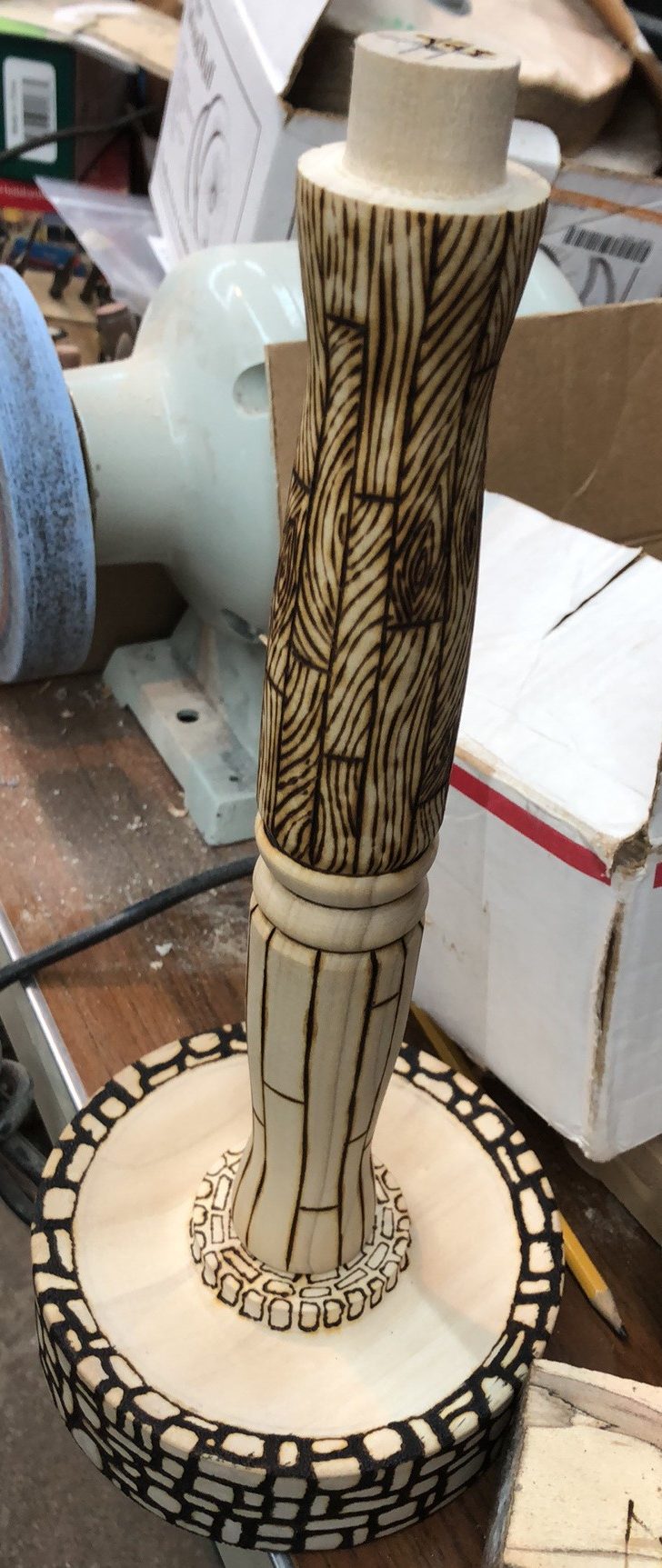
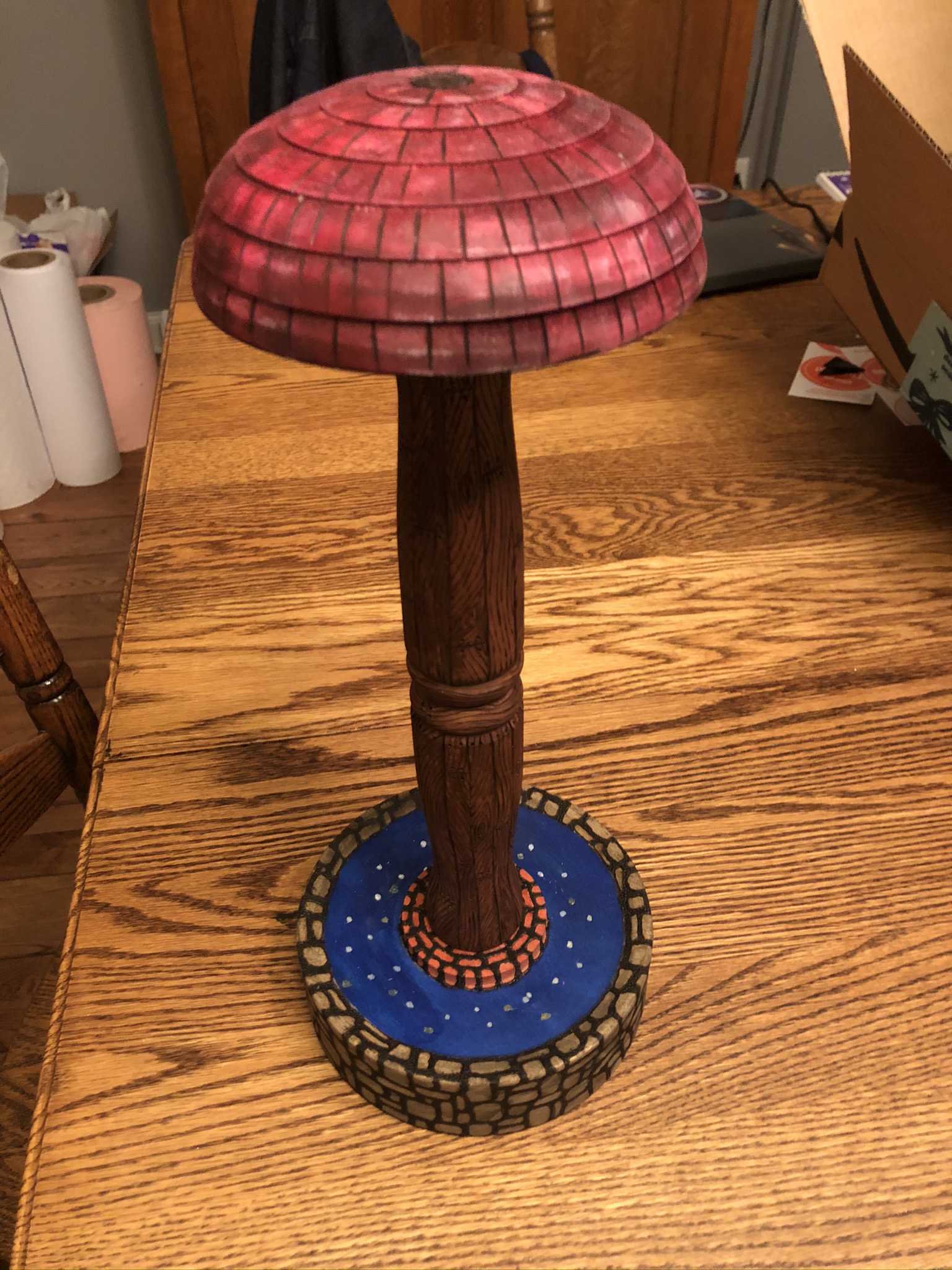
I ended up deciding to do an extreme amount of pyrography and make a wig stand that looked like a wishing well. I started on the bottom, making the blocks around the outside and the bricks around the inside of the “pool”. ALL of the black parts that you can see around the blocks were burned in, leaving a dimpled texture to the “grout”.

All of the black lines you can see was done with a wood burner. Yes, it took a LOT of time! On the base, that thick black line is actually textured with an endless number of dots, that served to burn the wood and leave a dimpled texture. It seemed weird burning fake wood grain on wood that already had a grain, but it turned out pretty good. This picture is about half way done. I had to stop because the smoke kept drifting into my eyes.

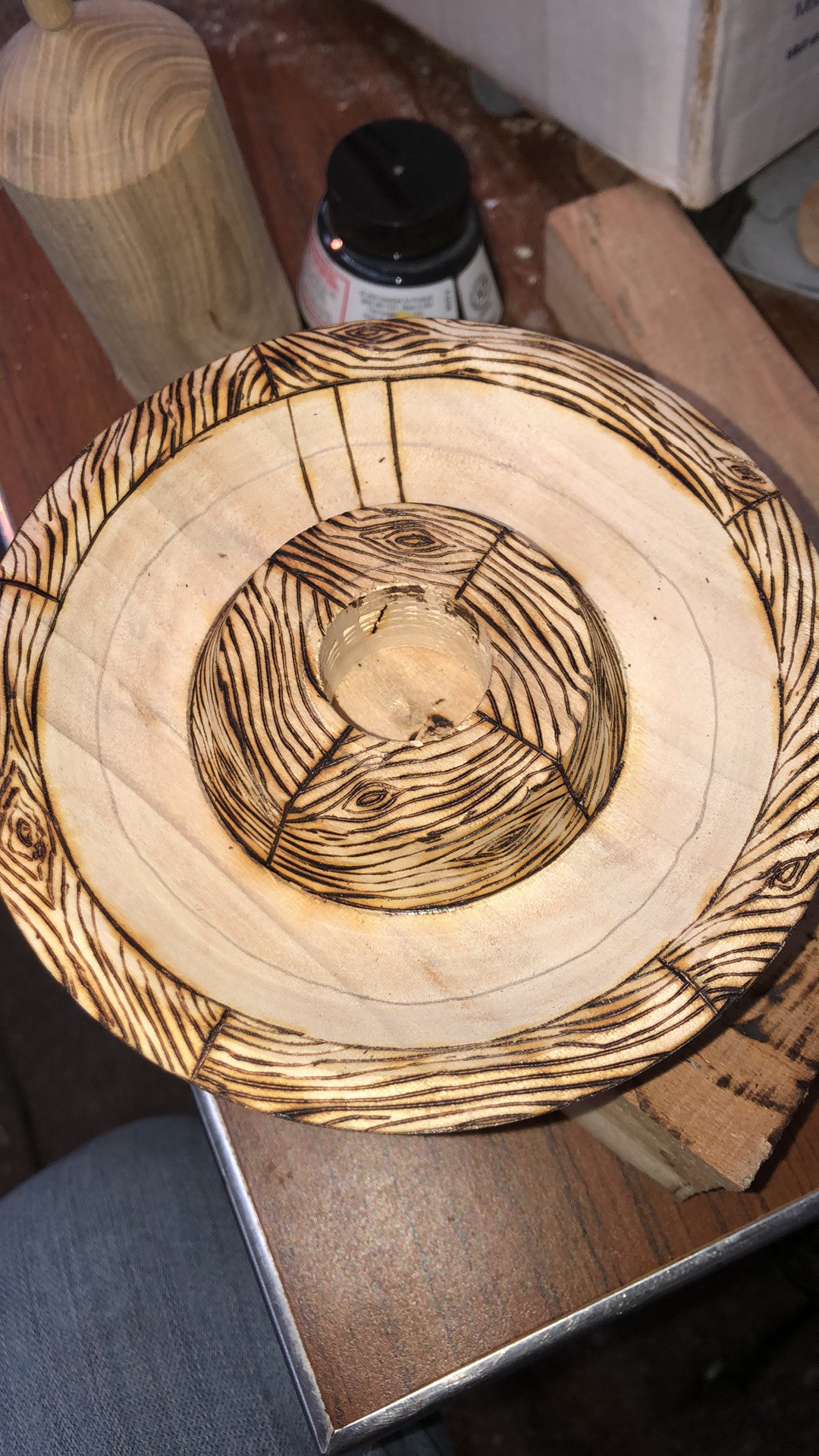
Once I had the bottom and the stem done, I had to figure out what I wanted to do with the top piece. My first thought was to hand carve all each individual shingle, but decided I really didn’t want to do that much carving. Then I thought do more wood, but since it’s all round, I didn’t like the way it looked when I drew it out. I decided to put the top back on the lathe and cut in lines for the shingles, then burn in each shingle. Then, I had to figure out what to do with the underside. That part could be fake wood!

I put the “beams” in, then started doing the individual boards.

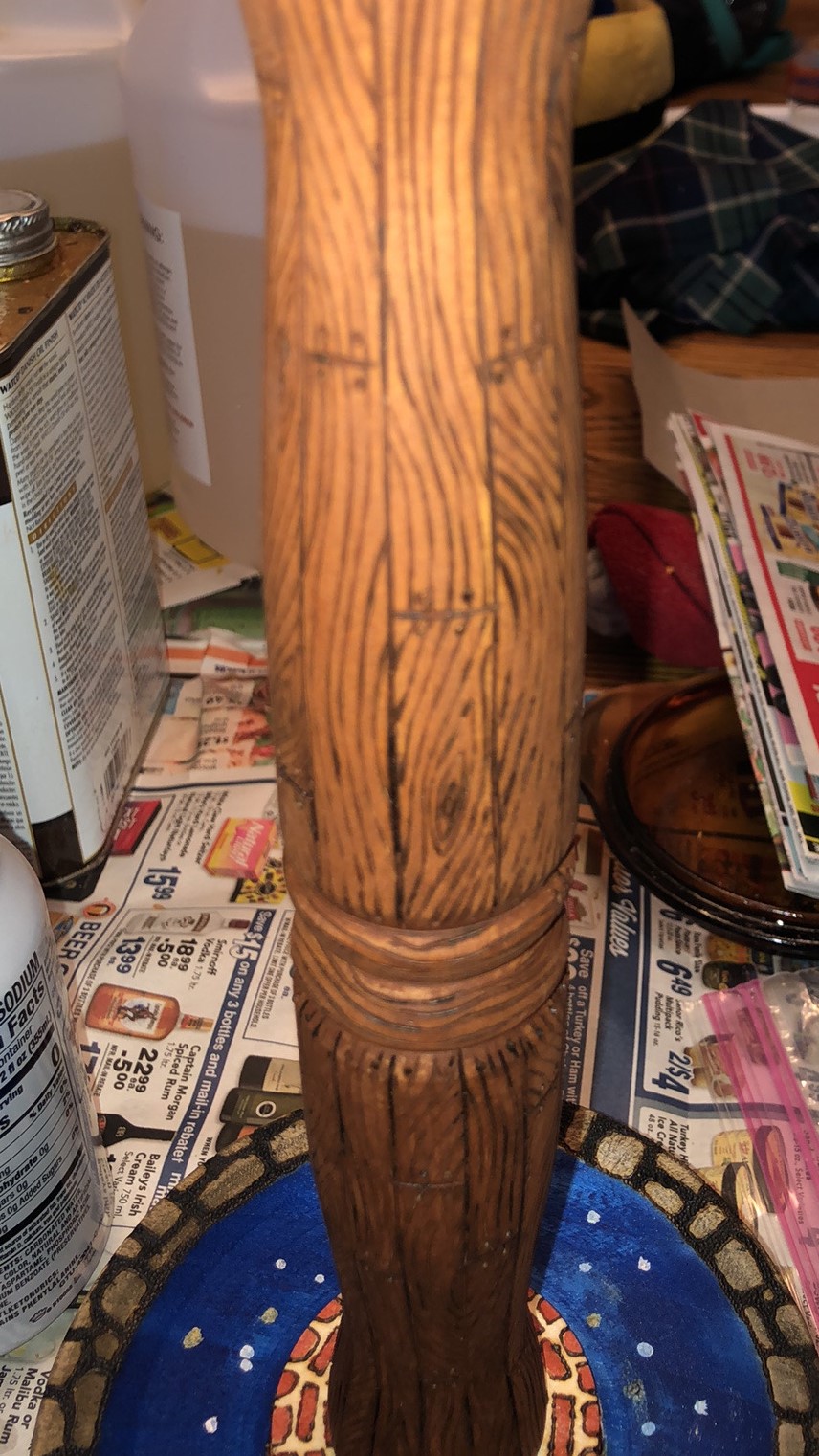
Once all the turning and burning was done, coloring was next. India inks come in a wide variety of colors and the wood burning that was done actually acts like a dam to keep the ink from leaching out onto the rest of the project.

Grey for the blocks, terra cotta for the bricks, blue for the water and brown for the wood. The coins in the fountain are acrylic paint dots. The ink won’t stick to the paint, so it leaves little circles. In this picture, you can see the colors, and just how much burning there was. I even burnt nail head into the wood next to each seam.

The last bit to do was the top piece. I had some “cranberry” colored ink that looked like it would be perfect! The only problem was when I put it on the wood, there was such a dramatic difference between how the end grain and the side grain took the ink, it looked really crappy. The end grain looked almost brown and the middle looked light and shiny. To fix it, I started dry brushing other colors of ink. After a little white, some yellow, some scarlet, and a little magenta, it seemed to be at a point where it at least looked like it was a little more planned.

I was happy enough to call this one done, then I showed it to my youngest daughter. She got that look in her eye and told me not to do anything and give her a few minutes to “take it up a notch”. She went to her crafting area and returned in 20 minutes or so with a teeny tiny leather pouch, with a working red draw string. It was filled with these little gold things that she’d cut off of some fabric that look like gold and silver coins. She figured if it’s a wishing well, it needs coins. We added a little sign, just to finish it out.

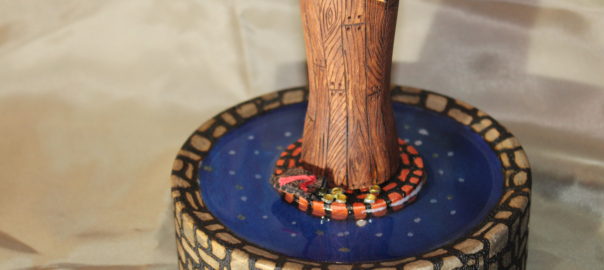
Here’s the finished product. Really like this one and hope the wishes for whoever gets this one actually come true. Especially if wish is to be cancer free.

Wishing closeup
Here is the sign, the coin bag, and the coins added by my daughter.  There is clear epoxy on the dark blue part, so it looks like standing water.
It’s hard to take pictures of the final product, because of the height of the wig stands. REALLY like the way this one turned out!
Here’s a close up of the underside of the “roof”, just to show how extensive the pyrography work is on this one. It takes longer than you might think to burn in all those little nail heads…

Calm

As my kids get older, get partners, get spouses, get children, get in-laws, and just plain get busy building their own – fiercely independent – life, our Christmas traditions have had to change.  Lay the nasty divorce of the past seven years on top of that and this holiday is unlike anything else we’ve been through.  This year, my kids and grand kids (at least the 5 kids and three grandchildren who were in town) did our thing on the 24th.  This was so they could all be at their own homes on Christmas morning, then go to their in-laws after they were done lovingly lying to their children on Christmas morning about the whole Santa Claus thing.  It was amazing!  The best word I could use to describe it was calm.  No drama, no arguments, and no old grudges leaping out of the depths to ruin the mood.  There was laughter, three grand babies fueled by too many Christmas cookies and nervous energy running around, and inside jokes that made “the significants” turn to my kids with a look on their faces that said, “why in the hell is everyone laughing at that?  I don’t understand.”.  At one point I just sat there, taking in the entire room, listening to the multiple conversations, and soaking up the memories.  Now, with a little time to process the day, there are some things that need to be pointed out.  “Need” may be the wrong word for whoever is reading this, but at least for me at this moment, I have a need to articulate what I experienced.

There is nothing sweeter, nothing to make you smile faster, and nothing so closely made from pure love as two toddlers giggling with each other.  It doesn’t matter what caused it and it doesn’t matter how long it lasts.  All that matters is that at the exact moment the giggles start, it is absolutely impossible not to smile.  It doesn’t just warm your heart; it reminds your soul that there is still something good in this world and it’s not as far away as you might think.

I’m physically a lot older than I think I am.  Yeah, I know that tired, wrinkled, graying face in the mirror should have set me up for a more accurate view of reality, but it clearly hasn’t.  I still seem to be struggling with the passage of time.  I swear that just yesterday I had a house full of preschoolers, so it still takes me by surprise to realize my babies have had babies. When the grand kids say “Dad?”, they’re looking at someone else, not me.  I’m “Papa” and while it feels pretty good to hear that, there’s still that generational distance that constantly surprises me.

Some things move at a glacial pace.  Emotional healing is one of those things.  It’s like water eroding rock.  No one seems to notice anything has happened, until an old picture shows just how deep the rut has become. Slowly, and with a great deal of practice, purpose, and patience, things get better with time.  Wounds of the past fade, current life events push old troubles further to the back of the shelf, and things change without much notice.  It takes days like this to put things into perspective, where you can assess the current situation, without the filter of all the past injuries, to see just how much healing has occurred.  Somewhere at about the two hour mark, I realized my kids are gonna be OK.

My “job” as a parent isn’t exactly done, but the expectations, obligations, and responsibilities that come with the title have changed radically.  When the kids were young, they expected their parents to plan everything:  When we’d start doing presents, what we’d eat for Christmas dinner, and even the order presents were opened.  As parents, we produced the show the kids attended.  Now, with grown kids, THEY get to decide all that.  It’s not about the traditions I’m used to, it’s all about the traditions they’re building themselves, even if they’re not aware they’re doing it.  Now, I’m attending an ongoing show they’re producing, instead of it being the other way around.

Just short of seven years ago, when the whole divorce started, the kids and I spoke of our post-split, post-court hearings, future as “life 2.0”.  Without all the ugliness that constantly overshadowed our prior time as a family, I think we all realized that we now had the power/opportunity to start over and make something better.  Positive. Less restrictive.  Less dysfunctional.  Something based on love, not control.  As I sat watching my children and grandchildren laugh with each other, actually listen to each other, help each other, and just be at peace with each other, it hit me that life 2.0 has already started.  No one fired a starter pistol to signal the beginning, but somehow, we’re already several laps into the new race, on a new track, and looking at a much different view of a much better finish line.  Things are going to be alright.  My kids are fantastic!  They love each other, they’re beautiful inside and out, they’re making good decisions, and they each have a strong moral compass.  Most importantly, even after all the insanity they were subjected to throughout their childhood, they still have the capacity to love.  Life is so much less stressful now than it was when the floors were covered with eggshells.  It’s amazing how things can change when all of a person’s energy doesn’t have to be focused on just surviving the day.  My kids and grand kids are healthy.  I have new passions, new friends, and new interests that will keep me occupied until it’s my time to go, and I’m not nearly as worried as I had been in the past that my kids will turn out OK.  They will, because they already are.

Calm.  Yeah, that’s the right word to describe the day.  Calm.    

A garage remodel? How hard can that be?

In the final stages of the turmoil that’s been my steady diet for the last 6+ years (the inevitable death of my marriage, the loss of my job, the loss of my house, the loss of some tools and the acquisition of new tools, sons-in-laws, grandchildren, court dates, etc.) I decided to buy a new house, since living indoors seemed like a really good idea at the time. That, and I needed a space where I could set up shop and start making again. Turning has become more than just a hobby, it’s become a necessary way to deal with stress. House-hunting has never been something I particularly enjoy, because there never seems to be a property that has everything you think you want. There’s always a trade-off and the trick is to try to find something where the trade-offs aren’t fatal. Great location, but missing a bedroom. Great kitchen, but the basement is musty. Perfect layout, but it’s right between a small business and a crack house. When I was looking for a place, I found a house that was the right size, the right layout, the right location, the right price, the right exterior, and it had a good sized garage, complete with a sub panel that wasn’t maxed out. PERFECT! Aside from the nuisance of the yard being absolutely infested by chipmunks (I’ve killed 25 already this year only to see two more of the little bastards frolicking in the driveway), the only real down side was the age of the house. When the building inspection came up (more or less) clean, I figured that “trade-off” would be manageable. I bought it quickly and started the planning to turn the garage into a workshop while I waited for the closing. Since there was a sub panel already there, I figured all I’d have to do was add a couple 220 lines for the new equipment and I’d be set. Then, after the prior owner moved all their stuff out, a cold, cruel, reality started to set in as we did the final walk-through.

The first thing I noticed was there was only one outlet in the garage. One. Who does that? My quick and easy electrical fix was obviously going to be a little more complicated. I talked with an electrician the realtor recommended to see what it would cost to add a few 220 lines and a couple of 110 circuits, expecting to hear that it would be no big deal. He told me there likely wouldn’t be enough capacity in the existing sub panel, so I’d need to run a new line into a whole new sub panel. He also wasn’t sure about the size of the line running into the house’s main panel, so it was possible that I’d need to “do a little upgrade work there” as well, which translated to putting in a whole new power line into the house from the pole outside, updating the main breaker box before adding a second sub panel. For what he wanted to charge, I could have easily built a whole new building in the back yard and wired it to the nines! The second thing I noticed was that this garage had been abused over the years. All of the walls had the remnants of tenants past. There were single shelf brackets sticking out at eye level and a ripped up place where the other had been torn out, random nails everywhere that must have served a specific purpose at some point in the distant past, and several places where you could see something had been bashed into the drywall, leaving either a broken place or a complete hole. Most of the holes had been “patched”, with the prior owner either gluing a new piece of drywall over the hole (honest to god, drywall glued on top of drywall) or nailing a thin piece of plywood over the hole, using an excessive number of old, ring shank drywall nails. The paint was faded and dirty, the single light fixture was circa 1972, there were cracks in the concrete that needed patched, and the whole place reeked of 40 years of general neglect.

Then winter hit. As I have done in every other house I’ve lived in, I left a case of pop and a case of beer in the garage to save space in the refrigerator. Things were good, until the temperature dropped below freezing. I went to get something to drink and noticed that all of the cans had frozen. What? How’d that happen? I put a thermometer out there and it quickly went to 6 degrees which matched the outside temperature. Then, I went to one of the drywall patch jobs on the back wall, removed the patch, and saw naked brick staring back at me. The front wall and the side wall were all the same. Apparently, back when the house was built, putting insulation into a garage wasn’t seen as a necessity. Neither were double paned, insulated windows, insulated doors, or concrete sealants. My remodel just got even more complex.

It was at that point I realized my plans to quickly be up and running weren’t going to work. The only cure for what ailed this garage was a complete remodel. NOT what I was expecting when I bought the place, but then again some of the best things in life come out of left field. On paper, it looks pretty straightforward: Rip out the old drywall, run the electrical, add some insulation, put up something to cover the insulation, and kick back in my new shop. I figured I’d use chip board, that way I could mount anything to the wall, anywhere I wanted, without necessarily needing to always be finding a stud. Armed with my new vision, I started sketching out options for tool placement, lighting, and electrical needs, which was all pretty straightforward. When the sketches were finished, the divorce got to a point where the end was in sight, and the weather became much warmer, the project was ready to begin.

Step one – the demolition: This was supposed to be the quickest and easiest and fastest part of the process, but cathartic violence always ends too quickly! As I started taking down big chunks of drywall, it dawned on me I had no way to dispose of it. A quick look around revealed I’d also need to get rid of chunks of mortar that had fallen on the base of the framing and been encased in the old wall, a bunch of quarter round trim some prior owner had put up to cover the corner seams in the drywall, and about 10 million rusted nails. Seriously, whoever did this work in the past must have been sponsored by a company who made nails and paid him based on the number he used. I started looking at dumpster rentals, but for the (relatively) small amount of garbage I’d have, that wasn’t anywhere close to cost effective. I called the city to see what others have typically done and got a crash course in governmental “assistance”. After two transfers, I got ahold of a woman who was in charge of bulk waste pickup. Her suggestion was to just “pile it on the curb where the picker truck could access it” and I’d be fine. When I explained what a mess that was going to make, pointed out the rain in the forecast and what it would likely to do the drywall scraps, and mentioned the 20 pounds of nails I’d collected so far, she made another suggestion. “Just put it in your normal trash can and the garbage truck will take it. Just be careful to stay under the weight limit.” How helpful! So instead of throwing away actual garbage, I was supposed to just keep cramming debris into the garbage can and stop before some mystical weight limit had been reached. I thanked her for her input and figured I was on my own. What I ended up doing was filling up whatever space was remaining in the normal garbage can with debris, then putting everything else out on the curb in boxes. Thank god for Amazon free shipping and daughters who compulsively buy everything online! Along with the debris issue, I saw that I had in fact been wrong about there being no insulation. One wall had what looked like sheets of some kind of fibrous “insulation”. It was 3/4″ thick, wasn’t tight between the studs, and was held only by (you guessed it) a handful of nails at the very top, leaving it to dangle between the studs like some kind of forgotten decoration. (I wondered if that’s what the guy did with his leftover insulation sheets he didn’t know how to dispose of, just hid them behind the wall?) As far as actually insulating anything, it served absolutely no purpose. Not only did I have to tear it down and stack it neatly by the curb, there were also another couple hundred nails to deal with.

Step two – permits: The next step was to call the city. I talked to a guy from my new neighborhood who had just finished a complete remodel of his kitchen – all without any permits – and he strongly advised me to do the work under the cover of darkness and NOT let the city know anything about what I was doing. Not wanting to get in trouble with the town, being too much of a Boy Scout, and resigning myself to the very real probability that someone would intentionally rat me out to the city, I decided to play by the rules. A quick call to the city told me $30 and a completed building permit form I could pull down from their website and I’d be good to go. I went down to city hall with $30 in hand, a completed form, and a friendly smile on my face. That’s when I realized I had unexpected walked into my second lesson on governmental “assistance”. Turns out, the woman on the phone was giving me an “estimate” of what needed to be done. The $30 fee quoted was for a building permit, but since I was touching the sub-panel, I’d need an additional electrical permit, which was another $40. Since there were two permits being issued for the project, I was “classed” as a more complex project, which would require a conversation with both the building inspector and the electrical inspector before I could start ANY of the work, including the demolition. (I didn’t have the heart to tell them I had already started the demolition, out of fear there would be a specific and costly “you-jumped-the-gun” fine.) The inspectors were both out of the office at the moment, but they would be contacting me “at some point”, then I could start the project. She took my money, took my forms, took both my dignity and faith in humanity, and she was the one smiling as I walked away.

Step three – insulation: As I was waiting for the inspectors to call me, I started looking into what my options would be to add insulation to the garage. NOT putting in insulation meant everything would still freeze and there would be nothing to dampen the sound, so this really wasn’t an optional part of the remodel. My question seemed simple: How do you insulate against a brick exterior wall? Very quickly, I found myself in this weird limbo place where everyone I asked would quickly suck air in as they pondered my dilemma and say, “yeah… good luck with that”. Everything I had been told was that you need some kind of vapor barrier to control the moisture, but I’ve never had a brick home before, so I didn’t know if that was true with brick. According to the experts on YouTube it was true, but those experts never seemed to be working with a naked brick exterior wall. I called a local insulation company to ask, but they didn’t want to answer my question, they just wanted to come out and make a quote to do the work. No help. I called the big box stores and the employees/department managers of Menard’s, Home Depot, and Lowes were all clueless. No help. I called a company who sold foam insulation and they said the only option was to use foam. Shocker! The price they quoted to do a garage was right up there with what the electrician had quoted, so I assumed they must be either close relatives or members of the same union. No help. I went to the store to get some groceries and the radio had a talk show on home improvement and the host of the show kept saying “if you have any questions about insulation, just call me”, so I figured I had nothing to lose, so I called him and left a message. I figured he’s on the radio, so he has to know what he’s doing, right? The man actually called me back the next day and we talked for at least 45 minutes. His direction was to forget about putting up any kind of vapor barrier. If the house hadn’t had any problems for as long as it had been there, the likelihood was very low there would be moisture problems moving forward. He said to buy extra thick insulation batting and just cram it in as tight as I could get it between the studs, right up against the brick and I’d be good to go. Right… Everything he said just seemed wrong to me, but he seemed to be the most sure of his answer of all those I had contacted, so I figured I’d take his advice since it was better than nothing.

Step four -permits revisited: A week later, the electrical inspector called. Since the form I had completed said I was the “electrical contractor” (which is what the smiling woman behind the desk said I should put) there was a problem. It seems I’m not registered with the town as an electrician, which is a requirement for getting an electrical permit as an “electrical contractor”. My options were to either hire an electrician and have them get a new permit (no, there is no refund for the permit I already bought) or to pay the fee to register myself as an electrician with the town. BUT, since I didn’t have the requisite training to be a licensed electrician, that option wouldn’t be approved by the town unless I could show some kind of training completion certification. I explained that I want to do the work myself, since it’s really not that difficult to do, but I have an electrician who’s going to operate in a “consulting” capacity and do the work inside the breaker box. He was OK with that and agreed my project could proceed. BUT… I’d need to have a separate electrical inspection and it would need to be timed with the building inspection. Somehow that sounded like not just trying to find a unicorn and a Sasquatch, but having to find a Sasquatch actually riding a unicorn. The building inspector called next. When I asked him why I needed a building inspection since I wasn’t doing any framing or changing anything structural, he explained that as soon as I started drilling holes through studs to run the wires, he would need to “ensure I had not damaged the structural integrity of the walls”. Apparently in the past, there have been major problems with people either drilling too many holes in a single stud, drilling the holes in the wrong place, or removing studs altogether. I tried to explain that the walls in the garage aren’t load bearing walls, the brick structure holds all the weight of the roof, but he was unmoved. He laid out the sequence of events that would need to happen: I could do the demolition, run all the wiring, then stop for the building inspection. When he was done, the electrical inspector could come inspect the electrical work. If everything was approved, then I could do the insulation and add the new drywall, then schedule him for a final building inspection. Wait, Drywall? I never said anything about drywall! I told him I didn’t want to put drywall up, I wanted to put up chipboard so I could hang whatever I wanted wherever I wanted without having to find a stud to anchor it. It was then he explained that having anything but drywall on the walls was a fire hazard and my house would immediately become “uninhabitable”, in clear violation of city codes. His suggestion was to put chipboard behind the drywall, but he couldn’t suggest where I might go to sell a kidney or a cornea to pay for the extra materials. Since he was being so helpful (too bad there’s not a specific font for sarcasm…) I decided to ask him about the proper way to insulate against brick. In all honesty, I was just trying to waste as much of his time as he was wasting of mine! His initial suggestion was to use spray foam, cementing my notion that somewhere there’s a club where all these people get together and formulate sinister pacts with each other. I’m pretty sure it’s not the Free Masons or Illuminati, because this group seems to be more shadowy than those groups. I told him the issues I had with using spray foam and he actually came across with a really, really good solution. He said to use the pink polystyrene sheets and wedge them between the studs at the back, which would leave a space between the insulation and the brick to lessen any moisture that would build up, then put normal, faced, batting up on top the polystyrene. Between the facing on the insulation, the coating on the polystyrene, and a thick coat of paint, I would have an effective moisture barrier and an air gap by the brick. I had a new plan that was only mildly more expensive and actually seemed better than what “radio guy” had given me.

Step five- insulation revisited: With the city satisfied, I finished the rest of the demolition, then start doing the insulation and drywall on the parts that would NOT have any electrical work. Generally, this meant the wall of the garage that was mostly made up of the garage door. To get the old drywall out and the new insulation and drywall in, I had to unbolt the garage door track from the wall. The first side went surprising smoothly and my confidence in the project increased. As I moved to the middle of the garage door, ripping out drywall, I ran into the bracket that holds the torsion springs. Now I’ve had to call people to replace broken torsion springs before, so I knew they were under pressure, or at least I should have known. When I took the last bolt out of the bracket holding the springs, a chain reaction was triggered. First, the bracket and the rod the springs were attached to spun out violently, which knocked the drill out of my hand and threw it across the room. The sudden spinning caused the rod to fall out of the pullys on the edge of the door, which caused the door itself to jerk violently, which caused several of the rollers to come out of their tracks. One of those rollers caused one of the old, rusted hinges to break in half, which caused the roller attached to the hinge to twist, which caused the roller bearing to break off the shaft. All of that happened in less than a second. Not enough time to swear, but enough time to realize just how lucky I’d been because I wasn’t standing directly in the path of the destruction. I had no choice but to pick up all the broken pieces, call the garage door repairman and schedule an appointment for their “next available” appointment. In the three days I had to wait for them to come out, I finished doing all of the demolition in the entire garage and finished the insulation and new drywall on the wall that had the garage door. The garage door people came out and had a real good laugh at my expense! Apparently, this is a common thing with homeowners who try to do their own garage door repairs. The way he said “homeowners” made me think he had successfully balanced his desire to say something a lot less nice with his desire to get paid. He was able to get the door working again, but told me his best guess was the entire garage door system had been installed in the early 80’s, because the sticker left on the door was from a company that went out of business about then. Just to hedge his bet, he added, “but it could be older, just judging by how beat up it is”. The garage door, the tracks, and the opener were all well past their shelf life, so “just to be safe”, everything would need to be replaced. GREAT! Sad thing was I couldn’t argue with the guy, since I could tell that the whole garage door system was old and rusty, I just thought it would be a “tomorrow” kind of problem. Replacing everything wasn’t cheap, but in hindsight it’s the one part of the remodel that was done better than I ever expected. The garage door fix-it people got to work. They removed everything, but I had them redesign the system. First, they put up new tracks for the door. These tracks were about two feet higher than the old tracks, so when the door goes up, it goes very close to the ceiling AND it eliminated the typical garage door opener handing from the middle of the garage. The garage door opener was mounted on the front wall of the garage on the end of the torsion spring rod. The light kit was stand alone, blutooth connected to the new opener and could be mounted anywhere and operated with the garage door or with the touch of a button. It also has a setup so when the door is closed, a heavy metal pin slides through a hole in the tracks for security to physically lock the door. Best thing is the new setup is so quiet, people inside the house can’t hear the door open or close. HIGHLY recommend this system to anyone who is planning to actually work in the garage! With that done, I could get on to the next step…

Step six – electrical: While I’ve been around electrical work in the past, I have to admit that I really didn’t know what I was supposed to do inside the box and had been putting off starting that part of the project. Luckily, I know people who know things! I talked with a guy who used to work for his dad, who was an electrician, and he was able to teach me enough so I could run the new circuits. After going to school on his knowledge, I realized that it really wasn’t all that difficult and I actually knew more than I was giving myself credit for having learned. As luck would have it, there was just enough space in the existing sub-panel to add the 4 new circuits I needed to run, and the total load wasn’t going to be that much, so the whole “you need a new sub panel” was complete BS. I had been warned that code says you can only run two wires through any given hole in a stud, and the hole had better be in the exact center of the stud, so I made sure to comply with those rules as I started planning out where the wires would go and began drilling holes through studs. It took me longer than I expected, but after a couple of days I had four working circuits that didn’t explode when I tested them out! Feeling very smug, satisfied, and happy to have extra money in my pocket from doing the work myself, I called the building inspector and the electrical inspector to claim my victory laps!

These sadistic bastards much have been sitting on their phones, just waiting for an inspector’s equivalent of a lottery win, like a “homeowner” all full of hope and happiness calling them for a final inspection. I called the building inspector at 9:30 in the morning and he scheduled a final inspection for 1:15 that afternoon. Then I called the electrical inspector and set up a time with him, but not surprisingly, they certainly didn’t coordinate schedules and I was told by his secretary he’d have to call me back. When a shiny new pickup with the town’s logo on the side pulled in front of my house at 1:10, I assumed that was the electrical inspector. He sat in his truck until a second shiny pickup with an identical logo pulled up behind him. To my surprise, it was the building inspector. Apparently, they had decided to do a “joint inspection” to save me some time, but their smiles made me suddenly very nervous. The building inspector went first. After an intense glance around the garage that lasted all of 30 seconds, he said, “you’re good from me. I don’t need to see anything else”. Wait, what? Apparently, my hole drilling was so wonderfully centered that even without actually looking at them, he was able to tell that I hadn’t “damaged the structural integrity of the house.” Next was the electrical inspector’s turn. First, he looked at the wires in the wall and quickly pointed out I ran all of the wires for all the new outlets a foot off the floor, then up the side of the studs, instead of waist high. He gave me a side-eye that I’m pretty sure was meant to crush all happy dreams and asked why I had run the wires “in a non-standard way”. I explained that I couldn’t find any codes that mandated wire placement, so I ran them low so if I put up a shelf or cabinet on the wall there would be 0% chance of accidental death or a fire from accidentally putting a screw through a wire. He actually smiled, mentioned it was a good idea and that he might write that into the code. Then, we walked over to the box. After about five minutes, he looked at me and morphed into a toothy grin, kinda like the Grinch in How the Grinch Stole Christmas. Then he proceeded to rattle off a list of things that needed fixed. For the work I did, I needed lower amp breakers and GCFI breakers and/or GCFI outlets on all four circuits I had put in, both the 220 and 110 circuits. Fine! That’s all I thought needed inspected, since that was all I was changing. Then he started in on the list of things that were wrong with the existing wiring, evidently forgetting that he had told me I didn’t need to do anything with the old wiring, since it was “grandfathered in”. Now, I was being required to rewire the entire breaker box to remove the neutral/ground jumper, isolate the ground from the neutral on each existing circuit, remove the one an old, existing outlet that was already in the garage because “it was no longer necessary”, create a new junction box on an old circuit, that was somehow tied to the (now removed) exterior garage light/lightswitch, and add more insulation to the existing wires where they clamp onto the breaker box to “get rid of all the visible bare wire. There would be no victory lap, at least not today. When I was done with all that, I could call for another inspection.

Turns out, the breaker box that I have is no longer made, so finding breakers that have the GCFI built in cost about $80 each for the 220v circuits and $60 for the 110v circuits. Thanks to Amazon prime, I got the 220v breakers for $45 each, and used GCFI outlets on the head of the 110v circuits, so the total cost for the GCFI’s dropped under $125. Then, I spent another day basically removing everything that was wired inside the breaker box so I could shuffle the white wires to one side and the bare wires to the other, and wrapped a piece of wire insulation around the wires that went into the box like some kind of electrical condom. A couple days later, the electrical inspector came back out and gave me a nice pretty green sticker to say that I was done with the electrical. Finally, my victory lap!

Step seven – insulation (continued) yet again: Now that all the wiring was done, I could finish all the rest of the insulation. With help from my daughter (thanks, Megan) we were able to cut up and install all the polystyrene, staple up all the insulation, and get everything ready for drywall. My initial estimates of it taking a day to finish the insulation turned out to be wildly inaccurate. There is no possible way the guy who framed the garage was sober, because there were no two studs that were the same distance apart. Instead of being a standard 14 1/2″ between studs, some were as close as 10″ and some as wide as 23″. He must have also been plastered when he bought the studs, too, because this is the worst quality I’ve ever seen in building materials. The discount bin at Menards has higher quality stuff! Some studs were warped so bad there would be a 2″ bow in the middle of the stud. Some were also twisted, so the distance at the back of the stud was a quarter inch or more different than the front of the stud. Rather than cutting all the pieces at once and installing them in quick succession, we were left with cutting each piece of polystyrene to fit the exact space for each gap. As I was finishing up, it dawned on me that getting insulation batting and drywall in standard sheets to land with an edge on the studs might be a problem later on. That, my friends, is called precognition!

Step eight- Install new back door: The back door of the garage presented a whole new set of issues. The existing door was 2″ thick, solid wood, but had a single pane glass panel in it and absolutely no weather stripping . I wanted to put in a steel insulated door, but quickly realized that wouldn’t be possible. When they built the deck off the back, they made the deck sit on top of the brick shelf of the garage floor, so the deck was higher than the bottom of the back garage door. That left an awkward step up to get out of the door. To “fix” that issue, they built a step/platform on the inside of the garage and cut 5″ off the bottom of the door to make is clear the new step. If I replaced the entire door and frame, I’d have the same problem they did, but wouldn’t be able to cut the bottom of the steel door off without destroying the structural integrity of the door. I could order a custom door, but I figured the custom door people were most likely in the same shady society that electricians and the insulation guys were in. The building inspector (who turned out to be a really nice guy) just told me to add some weather stripping to the door and buy a replacement double paned panel for the window and it would be just as good as a steel door. A quick visit to Menards to order the new window panel and I was on my way. When it came in, I started the install and quickly realized that the guy at Menards had ordered the wrong size. I called Menards and was told “You got exactly what you ordered. You should have known that this replacement glass only fits a Mastercraft door before you placed the order, so there are no returns and no refunds.” In other words, the first guy lied to me about the panel fitting a “rough opening” like double hung windows, so I was stuck. I called the store manager, who did an exhaustive investigation and called me back within 3 minutes to tell me that it was all my fault, but he was willing to give me a store credit if I returned the “bad” window in it’s original, unopened package and ordered a new window from them. I wasn’t the least bit polite in my response, considering he knew I had already opened the package, which is how I found out the new window didn’t fit. I ended up cutting the window hole in the door bigger on all four sides and installed the panel I had already bought. It worked, but I still don’t think I’ll be shopping at Menards for a very long time!

Step nine – install new window: There is an old window on the back wall of the garage that is an odd sized, awning style, single pane window that has a small crack running through the top of the window. Judging from the layer upon layer of dust, I’m guessing it’s been that way for a very long time. I started pricing custom made windows and was surprised at just how expensive they can be. Clearly, window manufacturers are in the secret society, too! I started looking at how the existing window was framed in and how the outside of the window was finished and started calculating how long it would take to redo all of the framing. After looking at the price tag, time, and labor it would take to replace the window, I decided to see if the garage could hold an acceptable temperature this winter, and postpone replacing the window for another day. If it got too bad, I could always cut some of the left over polystyrene sheets to fit over the window. Step nine: install new window: Cancelled!

Step ten – drywall: My suspicions while working on the insulation about the malformed, haphazard placement of the studs would be an issue turned out to be spot on! Like the polystyrene, many of the pieces of drywall had to be trimmed in weird ways to get the edges to hit a stud and in a couple of places, scrap wood had to be nailed to the side of the stud to make the stud wide enough to reach the panel. I did learn several things while doing this part of the project. First, I have a new respect for people who do this for a living, because it really is dusty, labor intensive work that has absolutely no element of fun attached to it. Second, when I was a kid I hated being asked to write on the chalk board at school because the feel and texture of the chalk would send shivers down my spine. Drywall is just a massive piece of chalk, so the whole time I was trying to work, I was constantly trying to resist the “willies”.

Mudding the drywall came next. That’s a process where a chalky, pasty, joint compound is spread across the joints to level out any gaps, cover any mistakes, and leave the walls looking smooth. If having to handle the chalk like dry wall wasn’t bad enough, this stuff is straight from hell. Once the joint compound dries, it has the same consistency and effect as chalk, so the constant willies comes back to the front. It’s also really dusty, so when you sand it smooth, you get to either inhale all that dust or rig up some extensive network of shop vacs, dust collectors, and fans which only serve to cover everything on your property with a fine layer of white dust. The dust seems to be particularly attracted to black Suburbans. I intentionally put the first attempt at using the joint compound on very thick, thinking if I did it right the first time, it would save time later. Good thought, but it turns out to be a lot harder than it looks to spread this crap out and make the wall even. After sanding back the first attempt, it was clear there were multiple places that would need some touch up work and a second layer of joint compound. After sanding the second layer, I decided that “good enough” was going to be my new motto concerning drywall work. If you ever see my garage, you’ll see multiple places where the seams are visible, the joint compound is visible, and screw heads can be easily spotted. Go ahead, say something, I really don’t care. It looks better than it did, it satisfied the building inspector, and I’d rather shit in my hands and clap before doing anymore drywall work! It is good enough…

Step eleven: painting: Here’s a little tip, in case you haven’t done this before. Brand new drywall is thirsty. Really, REALLY, thirsty! I knew I needed to prime it first, and since the paint was intended to provide some level of moisture barrier protection for the wall, I bought a high quality primer and tried to put a thick, heavy coat on the wall. Once done, according to the can, it would be ready to be painted over in an hour. PERFECT! I set an alarm for two hours, figuring I’d let it dry twice as long before putting on the enamel paint. When the alarm went off, I went to the garage and was amazed at just how much of the primer had “disappeared”. After swearing for awhile, I went back to the store and bought another gallon of primer and put on a second coat. An hour later, the walls looked to be a consistent white, with no patchy or bare spots. Two coats of paint on top of the primer and the painting was easily the least complicated part of this whole project!

Step twelve – The FINAL electrical inspection: When the inspector came out the second time and told me everything I’d done was good to go, I thought I was done with him. Not so lucky! There’s a “final final” inspection that has to come before everything’s “legal”. I asked him why, if he’d already approved all the work and his response was clearly a sign of the times we live in. Apparently, some people will claim they’re only doing a little bit of work to lessen the cost of the project they report to the city. The thought is this that will prevent an increase in their property taxes. Then, once they get their green sticker, they do a whole lot of other work after the inspector has already signed off. Honestly, that hadn’t even occurred to me. I wanted to believe the inspector when he told me how shoddy the “extra” work would likely be, but I have to admit I was now secretly contemplating what other electrical work I could do after he finally left. For the final final inspection, I’m still not sure if he even looked at the electrical box, I really think he’s just nosy and wanted to see what my workshop looked like after I got all the equipment moved in and placed. After 30 seconds of “inspection” and 40 minutes of talking about woodworking projects, I was done with my final final electrical inspection and could take the permit approval stickers down.

Step thirteen – Celebration: This is by far the most adventurous project I’ve ever attempted by myself and I have to say I’m very pleased with the work that I’ve done. There are some things that still need to be addressed (like a replacement window) by I feel like for all intents and purposes, the remodel is complete! It was a LOT of work, but everything is finding a new place to be stored, all of the new machinery will power on without tripping breakers, and it won’t be long before I can make pretty much anything I want! Life is good, I tell you, life is very good!

Step What the hell?: About 6 months after the final electrical inspection was done, a woman with a clip board and a toothy grin rang my doorbell. She was very polite and identified herself as being from the city assessor’s office. She was inquiring if the work I was doing on my “garage remodel” was completed or not. I told her it was, then waited for her to explain why her smile just got bigger. Well it turns out, her job was to determine just how much my little project would increase the value of my house. THIS is why so many people do shady shit when it comes to working on their houses, because the government is all too eager to penalize people for doing things “by the book”. I took her to the garage and walked through all the work that was done. After what ended up being a very pleasant 20 minute conversation, I was able to convince her that there actually hadn’t been any “improvements” made to the property, all I had done was repair what should have been done right in the first place. She agreed that no realtor was going to jump the price on the home because I did work that no potential buyer would even notice and told me she was leaving the assessment where it was. I figure somewhere along the line, I must have had some good karma that just got cashed in.
Leftovers – Natural Edge walnut bowl

So a friend of mine from the turning club took pity on me because I had to get rid of a bunch of wood when I moved. I kept some, but it just didn’t seem like something I should/could spend a lot of effort on, especially so close to bulk garbage pickup day. He’s given me several logs of different species, and when I told him I really liked turning sycamore, the next thing I know he’s backing his truck into the driveway and we’re unload chunks of sycamore so big the two of us together couldn’t lift them. He really is a good friend!

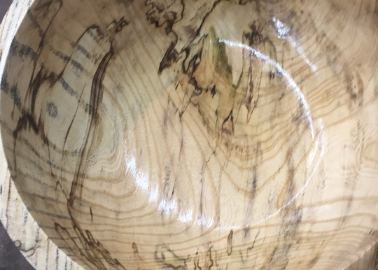
For this project, he gave me a big, nasty looking, chunk of walnut that needed a LOT of work. It had some checking, had some rotted spots that would need resin added, and it had a really odd shape from the way it was cut when the tree came down. Once I cut out where I figured the “best” place to make a blank would be, I realized there was enough wood left over to make another project. This bowl is from the leftovers. It also had some checking and had some bad spots.

I filled the bad spots with a dark red resin and decided to make it a natural edge bowl, since most of the really cool features were on the edge of the blank, hoping that would leave the cool part visible on the bottom of the bowl. When we started turning the wood, the knot on the side of the bowl revealed a rotten piece in the middle, which fell out. SO… back to the resin work. I was using a copper resin on another project, so I just used a little to plug the knothole and kept going. (Side note, what looks like iridescent copper resin when you pour it, become this gold color when it cures. Had I known it would be this bright, I would have used something else, because the two colors clash.)

One more turning session, some sanding, and a coat of Danish oil to darken it up a bit, this bowl is done.

From the top, the red resin and the copper gold) resin really stand out.
From the bottom, the really funky grain patterns really stand out

Mulberry piercing project

I helped our club demo what we do at this year’s “Summer Harvest Festival” at the Heritage Museum in Princeville. This is the second year I’ve helped with the demo, so I knew what to expect going in and tried to bring along a wide selection of projects to work on. I started with a wig stand to show what the club is doing to help cancer patients. It turned out pretty good and allowed us to talk with quite a few people when they’d look at it and ask, “what’s this”? Then moved on to a very small bowl made from a half rotten piece of redbud. The wood was in really, really bad shape, so my expectations weren’t very high when I started. Even so, the piece was ruined. About 95% into the turning, the piece cracked itself nearly in half while a group of kids and their mom were watching. Luckily, no pieces flew into the crowd, but it was a total loss. I ended up handing it to one of the kids and let him finish breaking the bowl in half. Who knew that would be such a big hit! I made a cedar bowl that turned out pretty good and gave that to another kid, on the condition he give it to his mom and tell her thank you for being a good mom. Yeah, it made her cry, but they were happy tears. I made little spin tops for some other kids (made them smile), made a pizza cutter for another guy in the club who was injured and couldn’t turn (he’s giving it to his sister and I’m sure they’ll both smile) , and spent some time making a very small ring box that I gave away to a little girl to hold her keepsakes in. More smiles.

On the last day, I put on a chunk of mulberry that I didn’t get around to turn at last year’s demo, so it was completely dry. After rounding it, I decided to make a box and started the hollowing process. The hollowing was slow, but the turning process threw chips all over the place. It seemed like the bigger the mess, the more people came by to watch and ask questions. When the day was over, I wasn’t done with the piece and took it home.

It took me a week or so to get the time to work on it and when it was done, there was absolutely no doubt I had created something really, really ugly. The wood color wasn’t all that great, it was way too “straight” looking and even though the wood was dry, it had moved from circular to slightly oval, so the lid only fit in one position.

After staring at it a few days, I decided to change directions. That’s when things just kinda started to happen on their own, in fairly rapid succession. I put it back on the lathe and thinned the middle of the box down to leave the rings or bands on the top and bottom. That helped break up the straightness of the piece. Once the wood was thinner, I decided to try out the new CNC bits I bought and started the tedious piercing process. That help lessen the plain, straight, boring grain. About 20 minutes in, my daughter said, “you should put some kind of word or saying inside the piercing”. After we talked, I decided to put a song/lyric from Bill Joel on the outside. (If anyone is familiar with the song, please don’t call the white coats on me, there’s a whole story and conversation behind why that was chosen that does NOT relate to suicidal depression!) It took a bit to get the stencil transferred, but once done, the piercing resumed. All the piercing made it prettier, but the lid still didn’t fit all that way. I put the lid back on the lathe, with the sole intent of just making the lid fit a little looser. Honest! Well, that’s when things just kinda happened, again. Since I had added bands and piercing to the box, I figured I should do the same thing to the lid. I thinned out the wood on the top and started the equally tedious process of piercing the lid like I had done on the sides. I liked it, but there was a hole in the middle where I needed to put some kind of knob or finial. I made one knob, that was short and wide, but that made the whole thing look too short and fat. I made a tall finial, but that just looked really, really bad, because the proportions were all wrong. I decided to take another piece of mulberry and see if I could make a small, hollow sphere. Turns out I could! When I sat it on the box lid, it looked ok from a size perspective, but it also didn’t really tie into the rest of the piece. Ok, I thought, I’ll just pierce it, too!

This is the final product. All things considered, this turned out a LOT better than I ever expected it to. Here’s to persistence, eh? Maybe not my best work, but I’m getting better at the whole piercing thing. It also got me thinking, and the next project will be a further step into the wonderful world of “This was fun, but I wonder if I can…”

Redwood from Russell

Lately, and I have yet to figure out the cause, other turners have been giving me pieces of wood to turn. I suspect it’s a combination of things. Maybe it’s pity because I don’t have my shop up and running (yet). Maybe it’s because they know that in the move I had to “dispose” of a large cache of wood that I had been storing. Maybe they’re just being nice. Maybe they’re getting rid of bad blanks they don’t want anymore. What I do know is that I’ve been truly thankful for each and every piece, regardless of the species or the condition of the blank. It’s good to have friends!

At the May meeting, a fellow turner, club member, and friend gave me a chunk of redwood, saying that he wasn’t going to be able to turn it. (His story to tell, so I won’t put it here!) I didn’t know much about redwood, other than when I was a kid my father used it to replace some wood pieces on the facia of the house. He claimed it wouldn’t rot out, no matter how wet it got. Judging by the work it took to replace those panels a couple years later after they had rotted, I’m gonna claim he was an idiot. All I remember about the wood itself was it had a reddish color, which certainly wasn’t like any of the typical wood I’d seen running through the timber. Russell was very open about the condition of the blank, and pointed out that in the years it had been in his shop, it has completely dried and had a couple of hairline cracks that had developed on one end. It also had a single spot near the edge that looked like the tree had suffered a trauma at some point and left a scar that would likely be very weak..

I started at a friend’s shop by making a circular blank, which removed 90% of the cracks and even got rid of the bad spot that could be seen. SUCCESS! Turning this would be the easiest thing, ever, right? Well, yes and no. Redwood, as I quickly found out, is very soft, which means it turns quickly and doesn’t take much “muscle” to shape. It is so soft that the tools just want to dig in like a starving man at a buffet. After making several uneven cuts that left the outside of the bowl extremely uneven, I conceded this project was going to require finesse!

The outside was finished and I quickly moved on to working on the inside of the bowl. As I got deeper and deeper, a little brown spot started to appear near the center. Not that big at first, but enough that it would make a darker circle in the wood as the lathe was spinning. I slowed down, but with each pass, the line got bigger until a second blemish in the wood, nearly identical to the one I had removed, appearedand that it was going to be right at the bottom on the bowl. It was also clear that in the many years this tree had grown since whatever injury was done, the wood had become unstable, leaving a literal hole in the wood. bummer! I cleaned up, brought the piece home, and tried to decide what options existed for fixing the problem.

Using two part epoxy didn’t work, because A) it was shiny, which looked out of place and B) it fell out almost immediately because the surrounding wood was too weak to hold the epoxy in place. I ended up deciding to leave it in, since any other inlay would likely result in the same failure. Initially, I dyed the bowl red, thinking a redwood bowl should look, well, red. I wasn’t counting on it looking orange, though, which is what color came out after the brown-ness of the redwood took the dye. ick! Most of the red was sanded off, then I put on a coat of black dye, let it dry, and started sanding it back. My hope was that it would accentuate the grain, but I hadn’t expected the bowl to warp as much as it did from the moisture in the dyes. What I was left with was an uneven blackening of the bowl that would be impossible to fully sand. In the end, I left the black and put two layers of red over the top. I figure if anyone says anything about the splotchy blackness of the piece or the (now gaping) black hole at the bottom, I’d just tell them the wood might have been salvaged from the rubble of a small millwright’s store run by Chinese immigrants that was lost in the great San Francisco fire. Or, it might be that I should have thought about what the final look was going to be before I started the finishing process…

Thank you, Russell, for the blank. I hope I did it justice!

Overall, I like this one. It looks like it’s been burnt with a blowtorch, only it’s just dye. I think this one will stick around for awhile…

President’s Challenge: Hole

The requirements for my woodturning club’s next president’s challenge is pretty simple: Put a hole in a perfectly good bowl. There were some subtleties, like no filling the hole and natural holes don’t count, but there wasn’t any restriction on how the holes were made and nothing that said there could only be ONE hole. Since I’ve been taking a more active role in the club, I kinda feel some pressure to do something creative and not just phone it in, so I started thinking about what was possible.

I thought about drilling a bunch of randon holes in the blank, then watch as they changed shapes as the bowl was turned. That didn’t seem like a very “controlled” project and it could easily end up looking really bad. I thought about making another birdhouse, since the hole for the birds to use would qualify for the challenge. That seemed like “same old same old”, didn’t feel fun, and the thought only lasted a few seconds. I thought about doing some kind of resin project, since I hadn’t done one of those in awhile. There really wouldn’t be any point to using resin, since the whole point was adding a hole in whatever gets made. I thought about making a clock and then drilling holes where the hour markers would be, since that would be something I haven’t made before. That seemed like a “someday” project, because I don’t currently have the clockworks that would be needed and I’m most likely going to do something with segmenting and resin inlays when I get around to making myself a clock. I thought about making a wizard’s pipe, but I’m sure the molds for bending the stem didn’t make the move. I thought about making a kids toy of some kind like a whistle or ring stacking thingy, but decided that would just open up a fight between the kids over which grand baby got to have it. I even thought about making a bucket with a hole in it, but didn’t want that stupid song running through my head.

I finally decided on doing some kind of piercing project. The gist of a piercing project is to turn something very thin, then take a power carving tool and make little holes in the project, aka piercing the wood. It can be a bowl, a vase, a goblet, pretty much anything. Some people do really elaborate patterns, some only pierce the wood on part of the project, and some people seem to see just how much wood they can remove, making the final project extremely fragile. Since all I have to use for the piercing (for now) is a cordless Dremel, I decided to go a little smaller scale and pierce an accent ring around a bowl.

The wood is cherry, and was a roughed out bowl blank given to me by another club member when I bought some equipment from him. (THANKS, Terry!) Since it was already rough turned, the basic shape of the bowl was set. Initially, I didn’t want the entire bowl to be thin, so I only thinned part of the bowl (from both the inside and outside) of where I wanted the piercing to go. The only bits I had to use were cheap “diamond” bits, but they were never really intended to do this kind of work, or this extensive of work. They got so hot they burnt the wood and ended up breaking down (I think there were four bits ruined by the time the piercing was done). The up side is the burning from the bits actually burned the inside of the holes, making the piercing stand out more because of the black that was left.

After the piercing was done, I put it back on the lathe to refine the outside shape, finish turning the bottom of the bowl, sand, sand more, then hand sand, then sand more, and finally take the tenon off. Below is the end result. I had wanted to use a friction polish, some laquer, then buff the whole thing until is was absolutely smooth, but all of that “stuff” is still packed away and I really don’t feel like digging it out. I settled on several coats of spray lacquer for a finish.

I think I like it, but really wish I would have added some color, if not on the whole bowl, at least on the strip that is pierced.

From the top, I like the way there’s no hard edge between the bowl and the piercings, but there is between the top rim. I’d like to say that was intentional, but it was the inevitable result of all the sanding that had to be done…
From the side, the “depth” of the piercing can be seen. It would have been a LOT easier if I had made that part of the bowl about half as thick, but I was afraid it would become prone to cracking.

President’s challenge – color

The club I’m in has a “president’s challenge” that runs for two months, then a new one starts. The intent is to incent members to create something that’s outside of their comfort zone. For March and April, the challenge is to “color it”, since many of the members only make things that are “brown and round”. The idea is that the finished product shouldn’t have any visible brown wood on it, or very little.

The current president is away from the club for a bit, so I’ve been asked to fill in. I figure if I’m going to be the acting president, I should be participating in the challenges. Not having a shop is a serious obstacle toward making things, but there are ways around everything. When I bought my new lather (which is my “forever lathe”, meaning I will never have to buy another lathe, since this one will do everything I can imagine doing) the guy I got it from threw in a couple of bowl blanks. One had a distinctive grain pattern that I thought was sycamore, but found out later it was elm. Thanks (again) to Bob, my friend and mentor, the bowl blank was quickly finished into a simple bowl. The inside of the bowl had a very distinctive grain pattern, but the outside wasn’t nearly as striking.

For the inside, I used a blue aniline dye to meet the challenge requirements. The bad thing about dying wood, is any blemish in the wood, be it tool marks or sanding marks, will be accentuated. EVERY mistake I had made in turning was now a glaring error. I had to re-sand all of the bad spots, then apply another coat of dye.

For the outside, I started applying the blue aniline dye, but quickly quit because it looked horrible. The end grain portion looked almost black, and the side grain didn’t take the stain very well at all, making it look like there was a vertical stripe on the outside. NOT the look I was going for. To cover the mistake, the only solution was paint. I decided to do the water marbling (aka hydro dipping) technique with silver and gold metallic spray paint, but control things so that none of the paint got on the inside of the bowl. The paint, however, decided that it was going to do whatever it wanted! I’d also forgotten that metallic paint doesn’t act the same as regular enamel spray paint and can get pretty clumpy. When I dipped it, I was left with a real clumpy finish and big globs of paint that had floated into the inside of the bowl. Great! More sanding! Mostly out of frustration, I decided to dip it again, only this time encourage it to be as gloppy as possible. When it came out of the water, the outside was covered with globs of paint that looked like snot. I patted it down with a wet paper towel, which left a textured finish, which I kinda liked.

More sanding on the inside to remove the wayward globs, then more dying to even out the newly sanded parts, and more turning to remove the tenon from the bottom. This is what I came up with. Not sure if I love it or hate it, but at least I have an entry in the challenge completed. Please forgive the low quality pictures, I’m still working on that…

I LOVE the grain pattern that came out on the inside of the bowl. Very distinctive lines!
In natural light, the gold and silver are a LOT more shiny. I like the texture, but not real wild about the overall look.

So… Now, I’m a teacher?

Hindsight is a wonderful thing, because most of the time you never see change coming. . Sometimes it just kings leans on you and curves the trajectory you were on, sometimes it sneaks up in your blind spot and pushes hard, and sometimes it’ll walk right straight at you and punches you in the gut. No matter how it happens, or how long it takes to fully run it’s course, it’s only when you look back that you can see just how different things have become. Woodturning is a good example. The oldest bowl I have from when I started turning (excluding the one piece I made in High School) is dated 2009. That means I’ve been at this for about ten years now. Really? Ten years? It doesn’t seem like that long ago.

When I first started, I made a lot of really bad stuff. I didn’t know it at the time, but in hindsight, there were some really hideous projects: bowls that looked like dog food dishes, vases that had the ugliest shape imaginable, and projects so bad I eventually burnt them in the firepit. Funny thing is, I can remember making them and thinking at the time what a good job I had done. I know that I’ve continued to learn, that my skills have improved over time, and that there is a cumulative (positive) impact that comes from time spent standing in front of a lathe – BUT – I still see myself as an “ok” woodturner at best.

Fast forward to now and somehow I’m an officer in my wood turning club. Wait, what? Don’t you actually have to know what you’re doing first? I was at an officer’s meeting where I was harping about the need to make the club more accessible to new turners and suggested the club needed to do more to attract and retain new, younger, turners. I threw out the idea of creating a training class, targeting people who had just started turning, or had a strong desire to learn, with a secret expectation that someone who actually had skills would pick up the idea and run with it. Everyone agreed with the concept, but no one raised their hand.  Next thing I hear is my voice saying, “I’ll do the class”.

Wait! What did I just say??? They all agreed, ensuring that the village idiot was going on the stage.

The next day I was looking at a blank PowerPoint presentation, trying to figure out what the hell I was thinking in trying to pass myself off as some kind of “teacher”. Me. The idiot. The guy who’s marginal at best. The guy who’s only been turning for 10 years. The guy who still forgets to tighten the tailstock before cranking up the speed on the lathe. What makes me think I know enough to teach? The empty powerpoint just sat there, mocking me.

I took a break and decided to switch tactics. Rather than make one Powerpoint with whatever “wisdom” I had, I decided to make an outline of all the stuff I remembered having to learn back in 2009, then I could group the information into modules and work on just one topic at a time. I figured if I took an honest stab at the initial creation, I could get the guys from the club who were actually competent to help fill in the (many) blanks. That didn’t seem quite so daunting. 7 modules later, I sent the material to some much more experienced turners in the club for review, sat back, and waited for my work to be shredded. It didn’t take long. Very quickly, the responses came back, but all they came back with were minor edits, most likely caused by the English curriculum of my Heyworth public education. Not what I had expected. It made me realize a few things. I must have done a better job than I expected in grouping the information into logical chunks, since there was no feedback concerning the “flow” of the information I was going to present. There was very little feedback about stuff that was missing, so I must have a more comprehensive understanding of the craft than I thought. While I had braced myself for a steady stream of “you should add something on _____”, it never came. That was when I realized that I may not be an “expert”, but somewhere along the line I’ve learned enough to be able to offer a pretty strong overview on how to get started.

I put a blurb out on the club’s public Facebook group (which is open to the public) and was absolutely stunned when 7 people (6 of whom were not already club members) were willing to join the club just to take the class. This is exactly what I had hoped for when I was harping at the officer’s meeting, but it suddenly became “put up or shut up time”.

This class was this past weekend. We started at 9:00, right on time, and the agenda was roughly “I’ll babble on for a couple of hours, break for lunch, do some hands on stuff, and be home by dinner”. That was the plan, anyway, but the only part that held was that we started right on time at 9:00. I was still reviewing slides when we broke for lunch because there was a LOT more discussion than I had anticipated, and we didn’t even get started on the hands on part until well in the afternoon. We finally stopped turning at around 6:30, and I suspect there were a couple students who would have been ok with starting something else about then and continuing to turn.

Yes, it took many hours to get the content for the class created. Yes, it took several hours to pack up all the stuff that I needed to take for the class. Yes, it took several hours to get the room “ready” for the class. Yes, it was a very long day spend standing. BUT… it was absolutely worth it! Initial feedback from those who attended support that the class is going to be seen as a total success. The question from the students wasn’t, “why did you waste my time”, it was “when are we doing this again and how to I get signed up!”

Now, looking back at the journey – from turning a simple bowl with my mentor looking over my shoulder and guiding my efforts, to standing in front of a group of people who believed what I was telling them – it turns out I can add “teacher” to my resume. Who woulda thunk it?

It seems change isn’t always a bad thing!