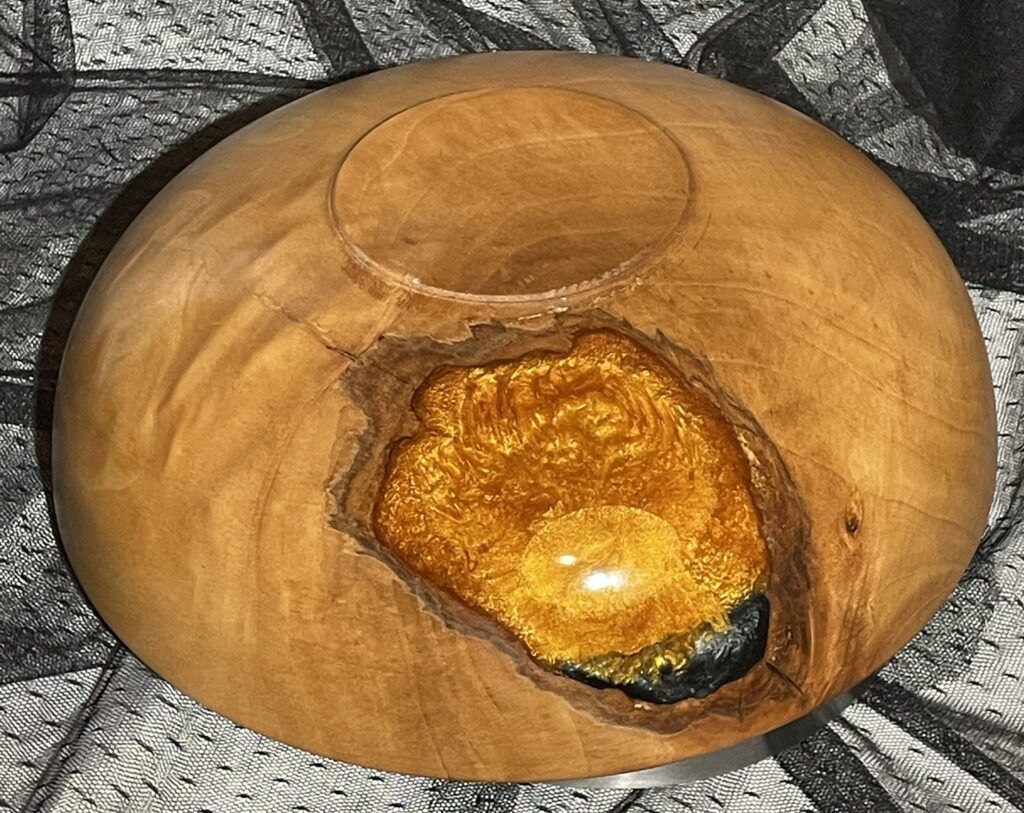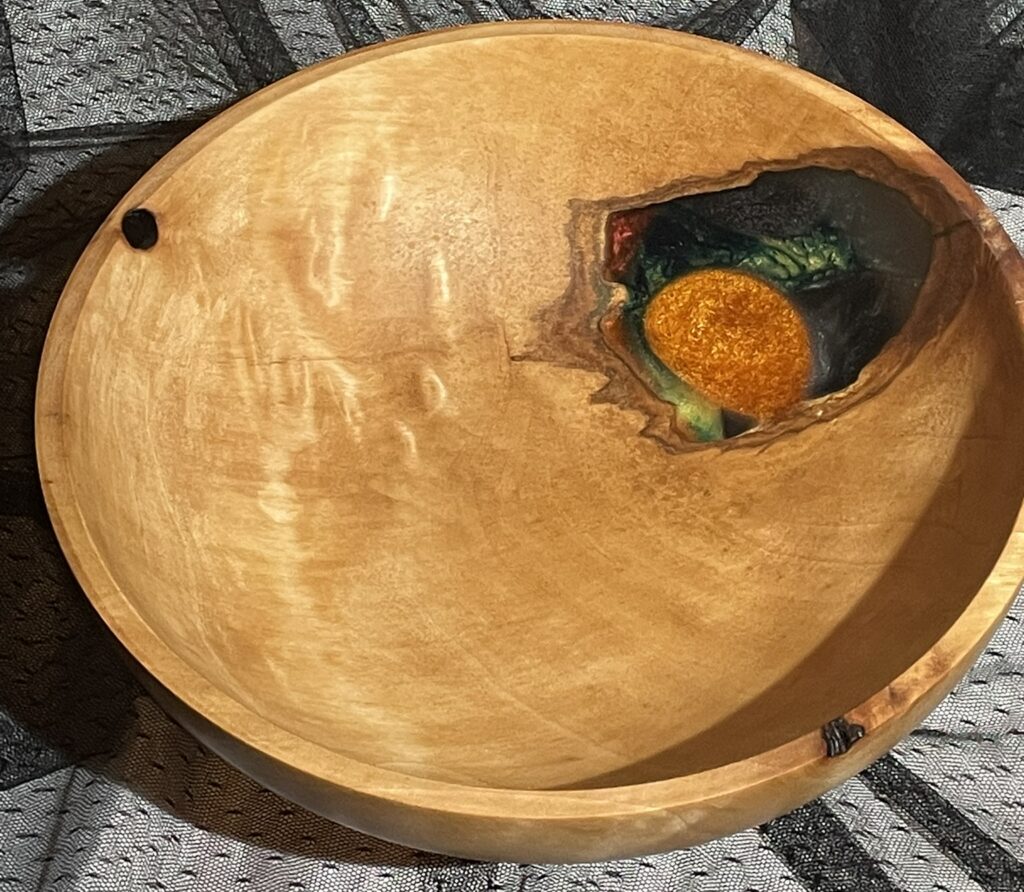
This one, I really like!
It started with a square blank from a river birch tree, given to me by a friend of mine that I had sealed and put away for later. (Thanks Russ!) All things considered, it was pretty nondescript, save one part that looked like there was a little damage on the side of the blank. I finally got the chance to put it on the lathe and started turning the outside of the blank to get it round and see what I had. That’s when it got interesting! All I could see was the outside of the bowl, and it wasn’t good. Most of the bowl had a very plain grain pattern, but the damaged part was bad. Really bad!
I took the blank off the lathe and set it aside to give myself time to figure out if I should keep going or cut my losses right there by throwing the whole thing in the burn pile.
The blank got “shuffled” in the shop and ended up in a stack of partially turned projects that had slowly gotten buried. When I built some additional shelving (because I’m a poorly recovering wood hoarder) I was shuffling old projects again. When I got to this one, I’d forgotten about it and decided to look at it again.
This time, the damaged part didn’t look so bad. Yeah, there was a pretty good sized “icky” part, but could be fixed. If the inside of the bowl was at bad as the outside, I’d just toss it. If not, well, there might be a way…
I put the piece back on the lathe and started on the inside, leaving things a little thicker that I usually do, to leave space for some kind of repair. The turning was pretty easy, once I got accustomed to turning over the gap where the bad part had created a big hole. When I got done and turned off the lathe and looks at what I was dealing with. One side of the bowl was still pretty plain, but the other side – the side with the damage – had changed. The grain had a shininess that was just starting to be visible on outside. The hole had changed too, losing most of the rotted parts of the blank, leaving a hole with clean edges. As inspiration is prone to do, I knew exactly how to proceed.
This one, I really like!
It started with a square blank from a river birch tree, given to me by a friend of mine that I had sealed and put away for later. (Thanks Russ!) All things considered, it was pretty nondescript, save one part that looked like there was a little damage on the side of the blank. I finally got the chance to put it on the lathe and started turning the outside of the blank to get it round and see what I had. That’s when it got interesting! All I could see was the outside of the bowl, and it wasn’t good. Most of the bowl had a very plain grain pattern, but the damaged part was bad. Really bad!
I took the blank off the lathe and set it aside to give myself time to figure out if I should keep going or cut my losses right there by throwing the whole thing in the burn pile.
The blank got “shuffled” in the shop and ended up in a stack of partially turned projects that had slowly gotten buried. When I built some additional shelving (because I’m a poorly recovering wood hoarder) I was shuffling old projects again. When I got to this one, I’d forgotten about and decided to look at it again.
This time, the damaged part didn’t look so bad. Yeah, there was a pretty good sized “icky” part, but could be fixed. If the inside of the bowl was at bad as the outside, I’d just toss it. If not, well, there might be a way…
I put the piece back on the lathe and started on the inside, leaving things a little thicker that I usually do, to leave space for some kind of repair. The turning was pretty easy, once I got accustomed to turning over the gap where the bad part had created a big hole. When I got done and turned off the lathe and looks at what I was dealing with. One side of the bowl was still pretty plain, but the other side – the side with the damage – had changed. The grain had a shininess that was just starting to be visible on outside. The hole had changed too, losing most of the rotted parts of the blank, leaving a hole with clean edges. As inspiration is prone to do, I knew exactly how to proceed.
I took the blank off the lathe and moved it to my basement shop to start the epoxy process. I decided to use an iridescent copper color to fill the hole, built a form to plug up the bottom, mixed the epoxy, and made the pour. Everything looked good, so I left it to dry. As I was walking upstairs, I heard a noise, but didn’t go back to see what it was. It was very late, I was tired, and it was a small noise at best.
The next morning, when I went downstairs to bask in my epoxy pouring success, I instantly saw what made the noise the night before. I swore, loud, angry and more than a little bit disappointed in myself. It turns out that the “small noise” I heard as I was walking up the stairs, was the the bowl with wet epoxy falling slightly. The epoxy that hardened had partially filled about half of the hole, with the rest forming a pool on the lower part of the bowl that shouldn’t have had epoxy at all.
That was the final shot. I would NOT waste more time on the bowl, would NOT spend more money wasting epoxy, and would NOT be finishing the project.
I moved on to other things. All turning and sanding was done in the outside shop, but I still used the basement shop for carving, wood burning, adding dyes to wig stands, or playing around with other epoxy repairs to other projects. On one of the other projects, I had mixed up too much epoxy, this time a dark, metallic gray, but didn’t have anywhere to put the extra. Since the ruined blank was sitting there, I set it back upright and poured the excess epoxy in the hole. There wasn’t much, but I could throw out the excess epoxy once it hardened when I threw out the botched blank. As I was leaving the table, I accidentally kicked the blank, causing the new epoxy to run, but didn’t really care since I was throwing it out anyway. The second pour also hardened in places I didn’t want and leaked on “good” parts of the bowl, but the hole still wasn’t filled. Next came an experiment pouring two different colors of epoxy at the same time to produce a unique pattern when they dried. I picked an iridescent green and an iridescent yellow so I could see the contrast when I made the pour. Since I’m not very good estimating how much epoxy I’ll need for a pour, I had extra of both colors. Like before, I put the ruined blank back into position and finished filling the hole with the same mottled pour of the green and yellow epoxy. This time, the bowl stayed where it was supposed to, filling the rest of the hold with the final part of epoxy to harden.
A few weeks later, when I finished working on a wig stand I’d been wood burning, I decided to take out the garbage. I picked up the shop’s trash bag, added the scattered cup, wrappers, and spare papers and started to leave when I saw the blank. I picked it up, too, thinking I could take it to the garbage can in the same trip. After putting the garbage bag in the bin, I paused when looking at the blank. I figured the bowl as a whole was a lost case, but wondered what the epoxy would look like when it was turned. There were multiple layers of epoxy, all at different depths, different colors, and VERY indiscriminately poured. Against my better judgement, I took the blank and set it on the lathe.
The next day, I was bored, looking for a new project to start. I saw the blank and decided I’d turn the epoxy back real quick just to see what it looked like, then start on a new project that had been rattling around in my brain.
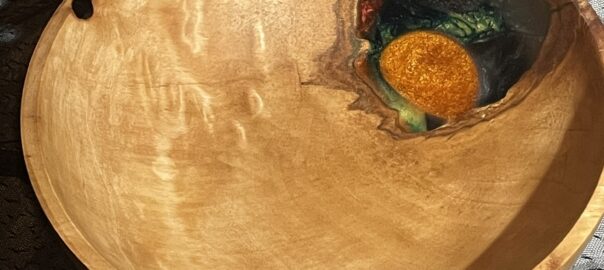
The epoxy didn’t turn well. Since it wasn’t a consistent surface, the tool bounced around like crazy and the epoxy didn’t cut, it chipped a little bit each time the tool came in contact. The more the high spots chipped off, the smoother the overall surface became and soon the bowl was releasing ribbons of epoxy. When I stopped to look at the progress, I was absolutely shocked at what i saw. The most obvious change was that the epoxy wasn’t the disjointed mess I expected to see. It had become what looked like a thought out pattern of colors where the turning process had created a design that looked surprisingly good. The change I didn’t expect, happened in the wood itself. Since I had left the bowl thicker than I normally would, I had room to remove more wood as I was dealing with the epoxy. On the outside of the bowl, there was a hint of a shiny grain pattern, but nothing that could really be identified. Now, the wood grain on half of the inside of the bowl had exploded into what is called “quilted grain”, with shiny grain spilling out everywhere.
I pulled the bowl off the lathe and looked at it, closely. From the outside, the epoxy looked like it was solid copper, with only a slight bit of the metallic grey peeking through and the shininess of the grain was almost incidental. The inside, by contrast, revealed the shininess barely noticeable on the outside had become a whole line of grain known as “quilted grain” that is unique. All along the line, the shininess stood out against the plain color of the wood and the starkness of the epoxy. The epoxy had shifted to where almost all of the copper and black was unseen, with a collection of the “extra” colors creating what looks like a hot spring pool. Totally unexpected!
This one started as a project destined to become designer firewood. It endured a series of accidents to finish as a truly unique piece that will be hard for me to part with. I don’t mean to be all new age in my thinking, but projects like this always make me think of how the universe works. Did I plan this? Not really. Did I expect this to happen? No, not at any point. How did the final result look so good? Well, that’s the point where I just step back and choose to believe that there has to be something, somewhere, that has influence and isn’t afraid to see things through. From the tree growing the way it did, but hiding the wood grain it truly had, to the multiple “mistakes” I made when doing the epoxy work, to the knee jerk reaction NOT to throw it away, to the way everything just seemed to work out at the very end, well, it seems pretty clear to me that I wasn’t the one controlling everything.