When I wrote about missing my friend, I talked about finishing a project that Bob had started and the pressure that in all honesty, consists of knowingly punching way above my weight. That has been on full display, lately.
For background, Bob had the same tendency to hoard wood that all wood turners get. When someone asks, “hey, I’ve got some fresh cut trees at my house, and I was wondering…” the answer of “yes, I’ll come get the wood” can easily come before the questions is fully asked. This was one of those times. Bob had gotten a call saying someone had some box elder logs, most of them had already been hauled away, but he could take what he wanted.
He said yes (not surprised) and asked if I would help him unload it from the trunk of his sleek little race car. I agreed, thinking I would also help him with the whole process it takes to correctly harvest green wood and get it ready for the initial turning. I had never actually seen box elder wood, but I figured it would be like any other kind of wood. As we were looking at the logs in his car, I could immediately see there were issues. The wood was still VERY wet (so it would crack quickly and easily if not addressed properly), it came from the base of the tree (which generally yields less grain variation, making the wood “bland”), there was visible damage to the wood from the way it was taken down, and the way it had initially been cut wasn’t optimal. As we started to lift the first log out of the back of his car, I said, “what am I missing? This looks like it’ll be a pain in the ass to break down and the likelihood of a decent turning blank seems pretty low”. I remember him smile and just say “bugs”.
Somewhere, an invisible bell rang and class was in session.
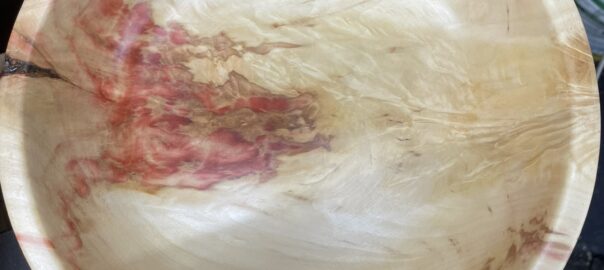
Bob split the log in half (longways) with his chainsaw, to let the pieces fall onto their sides. Looking at the cut he’d just made, I was immediately gob-smacked by the red and pink color that ran through out the log. I’d never seen anything like this before and just stood there. I looked at Bob, who had that smile back. He pointed to the wood and said “bugs” again. I was very confused. Then he explained that box elder is extremely soft, naturally has a very light color, and a very un-remarkable grain pattern. BUT… if the tree had been infested with the box elder bug, then Mother Nature takes over and something amazing happens. There’s something about the interaction between the bug and the wood that releases a certain amount of dye into the tree, but the bug doesn’t actually have to burrow into the wood for it to happen. That leaves the unique color and color pattern in the wood, but NOT the “bug holes” from the little critters burrowing into the tree itself. From there, and as the tree grows, whatever causes the discoloration spreads up and down the tree. This piece of wood had the unique coloration running the length of the wood he had saved.
We spent the rest of that afternoon cutting up the log, discarding the pieces that couldn’t be used because of damage or the way it had been cut, and “rough turning” what was left to allow better drying. In all, Bob came away with three rough turned bowl blanks. One split itself nearly in half within a day because of the way it had been roughed out, but not sealed. One was ok, but it didn’t have the color and was just plain, white, wood. The last was full of the color pattern and hadn’t split itself, but there was a damaged spot on what would be the underside that would have to be repaired at some point.
Then Bob died, he and his family gave me a LOT of his wood hoard, and I found myself staring at the blanks. Through quiet tears, I started addressing the two box elder blanks to see what repairs would be needed. I was in no hurry to mess up wood that obviously had special meaning to Bob, especially knowing there was very, very little chance of getting a second try at making something Bob would have been pleased with. That was the first time I chickened out. I decided to do the repairs, without committing to the whole turning. The repair part was easy, just add a little epoxy to the damaged parts and let it cure. Then I could wait. I left the larger blank sit, since I’m still thinking about possibilities, the final outcome, and to be honest it has more emotional weight to it, weight I could easily be crushed by. The smaller blank was ready. The repairs were done, the moisture level was low, so I put it on the lathe and then stopped. I was looking at the chucked up bowl and it suddenly hit me that I was actually looking at the point of no return. This was Bob’s, not mine, and if I messed up at all, I couldn’t just burn the evidence like I was comfortable doing with projects that were 100% mine. He would know. More importantly, I would know.
I took the blank off the lathe and set it aside.
For weeks, that bowl blank just sat there, watching me, flaunting the color that could be seen, hinting at promises of what else was hiding beneath the wood grain; all the while my heart slumped with the pressure of all the “what ifs” that could happen. I talked to a daughter, who told me Bob wouldn’t have given me the wood if he didn’t want me to turn it. I put the piece back on the lathe and turned it on. Starting the turning process for a second time was just as horrible! The wood turned like a dream, but I suddenly didn’t trust myself. I didn’t trust what I was seeing. I , didn’t trust my ability to make something Bob would approve of, I absolutely didn’t trust my ability to transform something Bob saw promise in into something worth making. I turned the lathe off, not wanting to risk going any further.
That’s how things went. The piece set on the lathe for days, I would eventually work on it for a very small amount of time, then turn the lathe off and go back to waiting. Over and over, day after day, as the weeks stretched by.
After talking to the initial daughter again, I made a resolution to myself that if Bob said I was good enough, well, I must be good enough to continue, so I did. The outside bit turned to show the repair had fully fixed the initial problem while managing to “blend” with the overall piece. I started working on the inside of the bowl and quickly saw the potential Bob had saved. As the bowl took shape, Mother Nature slowly revealed all the color and grain patterns that had initially been shielded from view. I took the bowl off the lathe and looked over the progress so far. The bowl, while looking like a basic bowl, flashed unique color and grain patterns that were completely unexpected. I smiled and started to remount the bowl to start the process of removing the tenon and finishing the base, but that’s when everything that could have gone wrong, did.
As I was looking at the bowl, it slipped. Not the kind of slip where you drop your phone on the couch, knowing the damage would be minimal at worst, this was like watching a phone drop down a stairwell and ricochet between the handrails all the way down while a sinking feeling that can’t be stopped plays out in slow motion. The nearly finished bowl landed on a large piece of wood I had shoved under the lathe. I heard a piece of the bowl crack, followed by a smaller sound as the broken piece of the bowl glanced off the wall of the shop. I saw it bounce up from the log, only to smack into the harsh angle of the under side of the tool rest, then land on the concrete shop floor, roll under the lathe and across the shop, and finally come to a stop after it hit the bands saw.
I just stood there, trying to process what had just happened. After what seemed like minutes, I could have sworn someone said “just leave it”, so I turned, walked inside, and went to bed. Tomorrow, I would assess the carnage, but for now, I needed to let the voice in my head have their say.
The next morning I retrieved the bowl to assess the damage. A piece had indeed splintered off the rim, leaving what looked like a bite had been taken about a half inch deep, right on the rim. I could have fixed it with the same epoxy I’d used the first time, but instead I decided to lower the height of the bowl by whatever it would take to get rid of the bite mark. The next issue was to figure out how to fix the damage that must have been done when the bowl bounced up to hit the underside of the tool rest. This left a “dent” that wasn’t just deep, it was also “scuffed up”. Filling the hole with epoxy, even matching the epoxy used on the first repair, would look horrible, so the only choice I had was to use what little thickness I had in the wall to turn out the scuffy dent. The marks left from the rolling trip across the garage were superficial and could most likely be sanded out. It felt like a plan, but there was no assurance everything would work out. More concerning, I couldn’t hear Bob’s voice in my head, just quiet.
I took a deep breath, put the now broken bowl on the lathe and started fixing things. Removing the chip out of the rim was the first part and from a purely technical point of view, the easiest to accomplish. Removing the dented and damaged part would prove harder. To get the dent out, about half of the bowl’s thickness would have to be removed. Taking that much wood away from the bowl would probably make the bowl less structurally sound, so I had to slightly change the overall shape of the bowl. I decided to leave some of the wood at the top of the bowl (that would have been removed anyway) to make the rim thicker, like there was a band running along the top of the bowl. When I was done, the dent was gone and I was convinced both stability problems had been fixed.
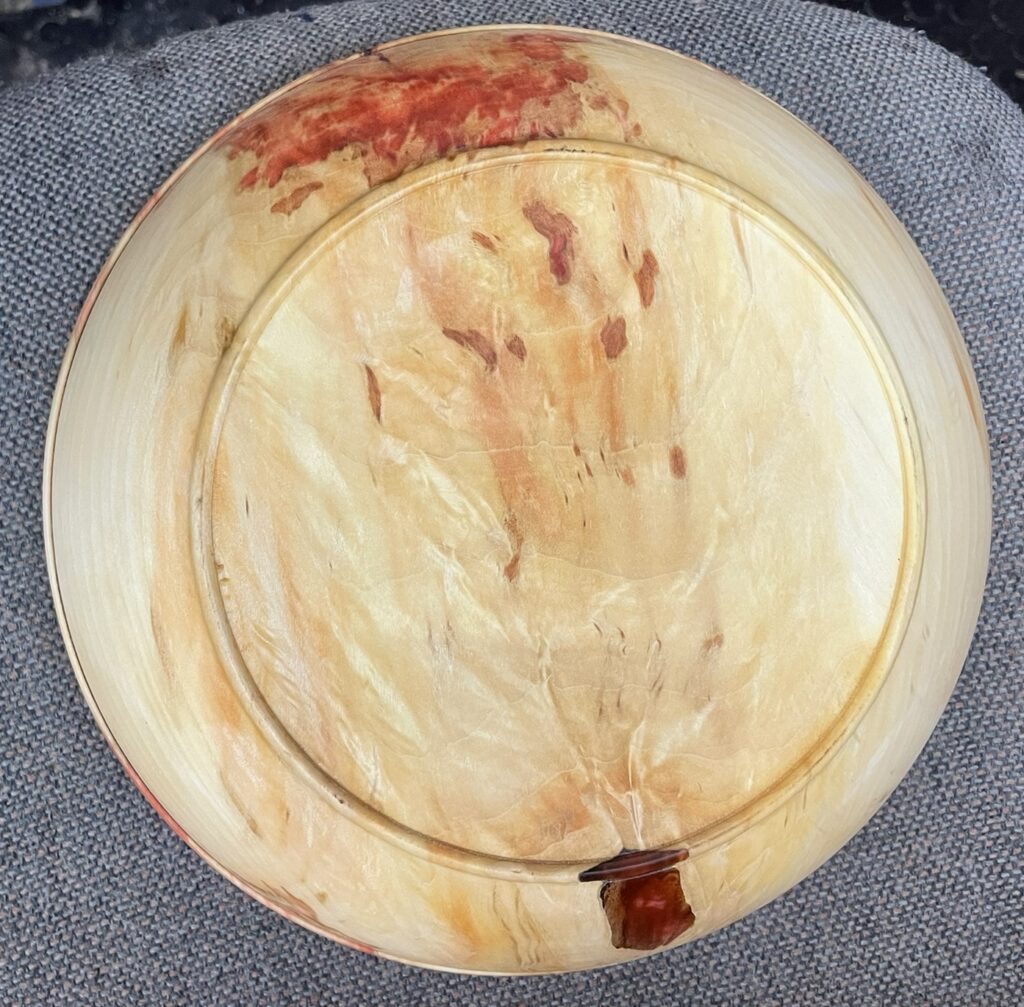
The last thing to do was remove the tenon and “clean up” the bottom, which was where everything went wrong before. This time, I switched chucks, carefully remounted the bowl and started on the bottom. The work done to remove wood on the side actually allowed me to make the base a little thicker than I’d initially planned, which also helped with the stability. There was enough wood there to make the “foot” wider, which made the bowl feel more solid.
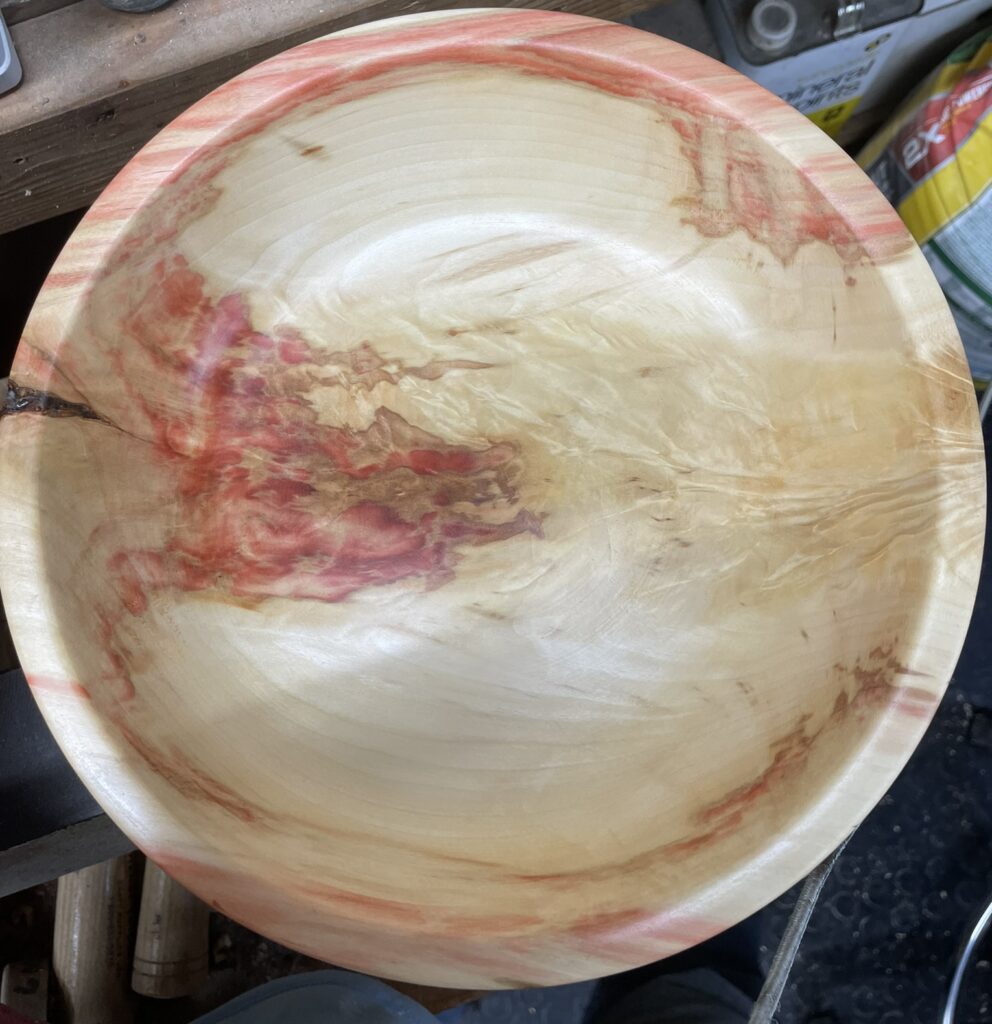
I took the now finished piece off the lathe, wiped off the random dust from sanding, and set the bowl on the mini-lathe to see what I’d created. That’s when the beauty of what Bob had saved hit me, all at once. The color is amazing, the grain pattern that came out as I turned the inside is completely unexpected, but the best part was the voice came back. I could have sworn Bob was standing right behind me when he whispered “you done good”, just like he’d done the first time I made a lid for a box that fit like it was supposed to. Tears came, again, from the combination of the affirmation I took from the voice, and the realization that although I’d destroyed the initial attempt, I’d fixed it exactly as Bob had trained me. The door to the shop opened and the boy came out talking about some game he was playing, but he stopped when he saw me setting there with tears in my eyes.
“You ok?”
After a few minutes and some hard swallows, all I could say was “it’s beautiful”, but not wanting to tell anyone that Bob had already told me it was good.
The boy knew about the bowl I’d been working on, knew where the wood came from, and knew what kind of pressure I was dealing with to “do right” by Bob. Although he’s not a woodturner, he knew I had made the finished bowl sitting in front of him and that it was better than most. He paused, was quiet, and gave me a quick squeeze on my shoulder, told me “it looks really good, Dad”, and quietly went back inside.
This bowl is one of those projects that won’t be given away or (worse yet) sold, it’s different. It’ll go up on the “special shelf” of projects that I’m proud of or show some aspect of what I do that makes me proud. It’ll be kept out of the sun to keep the color pink, but also kept out in the open where I can see them every day and remember.
This one, I’m sure I’ll remember “bugs”.
Bob would be so proud of you. At one point, he told me that you did beautiful work and he didn’t consider you a student anymore. He was always grateful that you still came over.
I think the highest compliment he ever gave me came as we wrapped up a “normal” night of turning. We were sweeping up the shop and I asked him what was on tap for next week. He looked me straight in the eye and flatly said, “I can’t teach you anymore”. I was crushed, because that was not the response I was expecting! I started to stammer through asking what I had done or said wrong when he said, “I don’t think I can teach you anything new, I’ve taught you all I can. I’d still like you to come over if you can because I like spending time with you and I think I’m learning from you now”. Not sure that was 100% accurate, but it sure did make me smile!